Publications

Papers from the lab and its collaborators in HCI, natural language processing, and health informatics.

184 papers. Lab members’ names are in bold.

2026

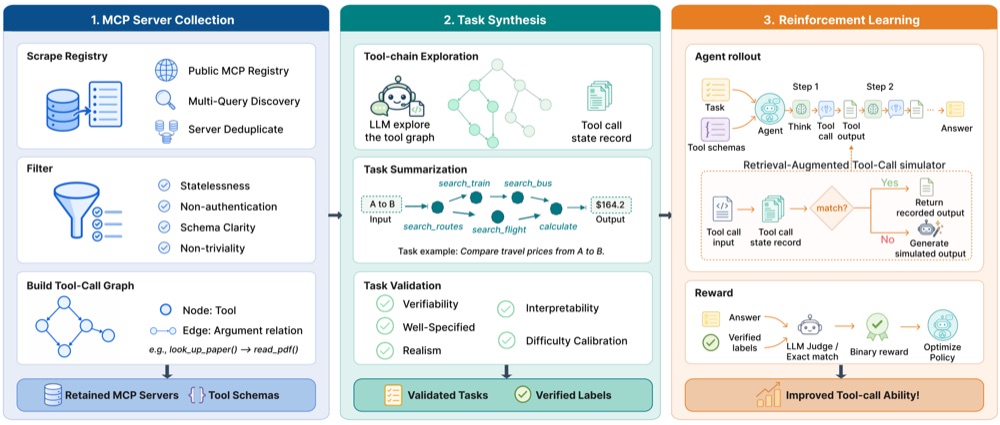
  1. Firefly: Illuminating Large-Scale Verified Tool-Call Data Generation from Real APIs

    Yuxuan Lu, Ziyi Wang, Yingzhou Lu, Yisi Sang, Jiri Gesi, Xianfeng Tang, Yimeng Zhang, Zhenwei Dai, Hui Liu, Hanqing Lu, Chen Luo, Qi He, Benoit Dumoulin, Jing Huang, Dakuo Wang

    NeurIPS 2026 Conference on Neural Information Processing Systems (NeurIPS 2026) Earlier as a preprint arXiv
    LLMs and AI Agents
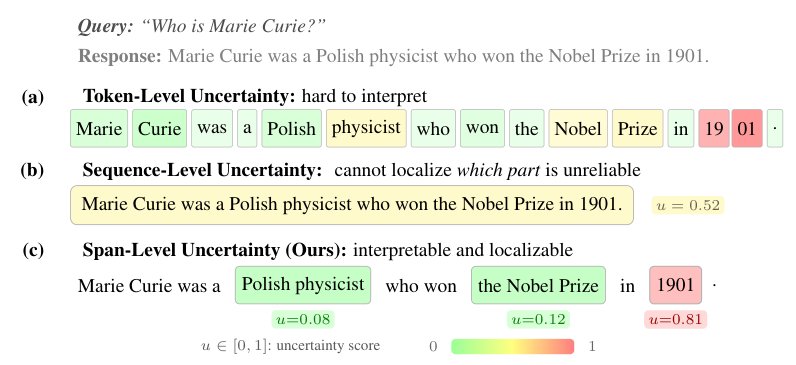
  2. SpanUQ: Span-Level Uncertainty Quantification for Large Language Model Generation

    Yimeng Zhang, Yingying Zhuang, Ziyi Wang, Ye Lu, Pei Chen, A. Gupta, SU Zhe, Ming Tan, Zhilin Zhang, Qun Liu, Manikandarajan Ramanathan, Rajashekar Maragoud, Edward Vul, Jing Huang, Dakuo Wang

    NeurIPS 2026 Conference on Neural Information Processing Systems (NeurIPS 2026) Earlier as a preprint arXiv
    LLMs and AI Agents
    Abstract

    Uncertainty estimation is essential for the trustworthy deployment of LLMs: it underpins self-refinement and serves as a decision signal for downstream systems, from verifiers to collaborating agents. However, existing approaches operate at suboptimal granularities: token-level scores lack semantic coherence, while sequence-level scores fail to localize errors. We formalize Span-Level Uncertainty Estimation (SLUE), a new task that targets the natural granularity for uncertainty: semantically coherent text spans, each conveying a single assessable unit of meaning. To address this task, we introduce SPANUQ, a lightweight probe that distills the uncertainty knowledge from expensive multi-sample inference into a single forward pass over LLM hidden states. SPANUQ employs a DETR-style span decoder to simultaneously detect spans and estimate their uncertainty via a Mixture of Beta distribution, trained with a principled combination of Beta NLL regression and contrastive ranking objectives. We construct SPANUQ-BENCH, the first span-level uncertainty benchmark comprising 20K prompts, 293K annotated spans, and continuous soft labels derived from multi-sample claim verification. Experiments on five LLM backbones show that SPANUQ consistently achieves the best span-level uncertainty quality , outperforming the strongest probe baseline and all sampling-based methods while being 10~20x faster. Its DETR-based span detector attains 0.910 F1, surpassing the best heuristic by 39.4%, enabling precise error localization that sequence-level methods cannot provide. The same architecture ports to five LLMs spanning two model families, with one probe trained per backbone, and we additionally observe that sequence-level uncertainty is partially decomposable, suggesting that span-level estimation subsumes sequence-level as a special case. The project page is available damon-demon.github.io/SpanUQ.

  3. StaRPO: Stability-Augmented Reinforcement Policy Optimization

    Jinghan Zhang, Fengran Mo, Tharindu Cyril Weerasooriya, Ruimin Dai, X. Y. Han, Yanjie Fu, Dakuo Wang, Kunpeng Liu

    NeurIPS 2026 Conference on Neural Information Processing Systems (NeurIPS 2026) Earlier as a preprint arXiv
    LLMs and AI Agents
    Abstract

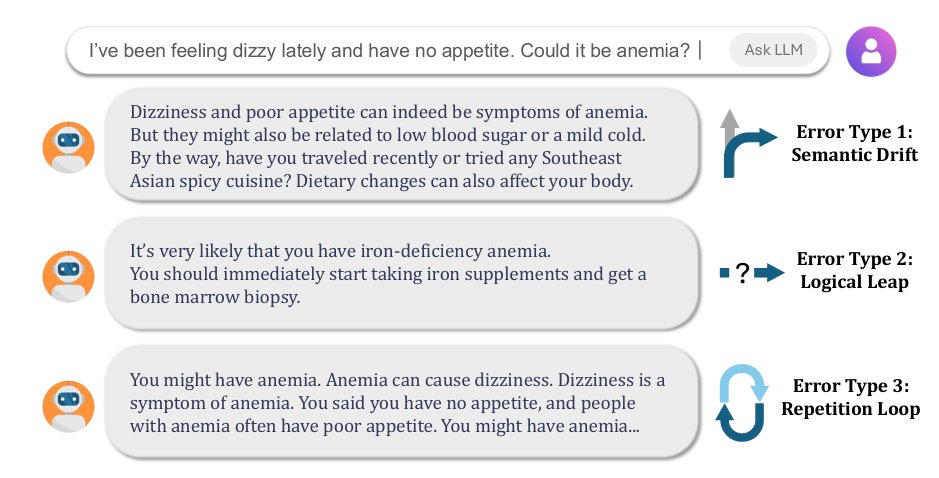
    Reinforcement learning (RL) is effective in enhancing the accuracy of large language models in complex reasoning tasks. Existing RL policy optimization frameworks rely on final-answer correctness as feedback signals and rarely capture the internal logical structure of the reasoning process. Consequently, the models would generate fluent and semantically relevant responses but logically inconsistent, structurally erratic, or redundant. To this end, we propose StaRPO, a stability-augmented reinforcement learning framework that explicitly incorporates reasoning stability into the optimization objective. Our StaRPO decomposes stability into two computable lightweight metrics: the Autocorrelation Function (ACF) to evaluate local step-to-step coherence, and Path Efficiency (PE) to evaluate global goal-directedness of the reasoning trajectory. These stability rewards are combined with task rewards to provide complementary and process-aware feedback. We validate the effectiveness of using ACF and PE rewards by showing their correlation with logic errors on two backbone models. Experiments on four reasoning benchmarks show that StaRPO consistently outperforms compared baselines and can enhance both final-answer accuracy and logical stability.

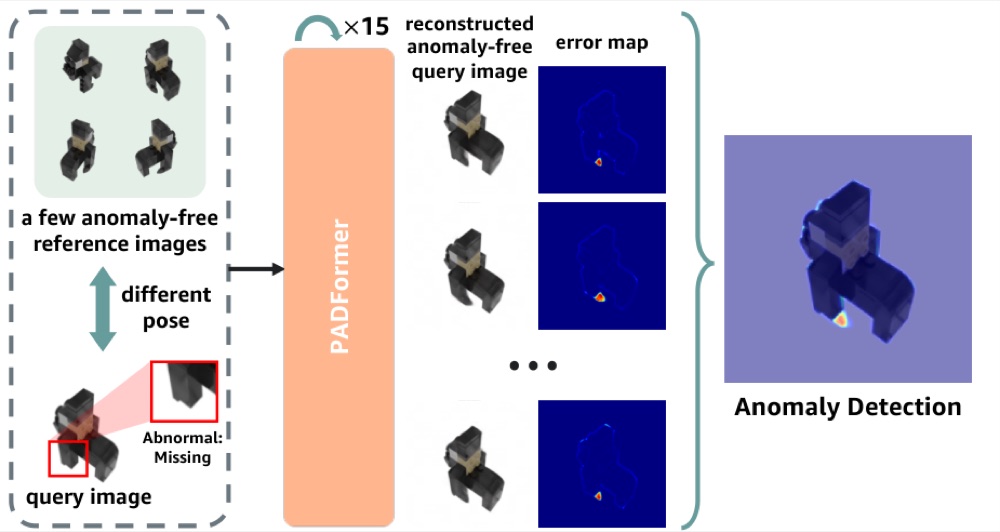
  4. PADFormer: Pose-Agnostic Anomaly Detection from Sparse View Images

    Ruiqi Wang, Yiming Qian, Fenggen Yu, Yuxuan Lu, Dakuo Wang, Hao Zhang, Jing Huang

    ECCV 2026 In Computer Vision - ECCV 2026, Part XXVII SpringerarXiv
    LLMs and AI Agents
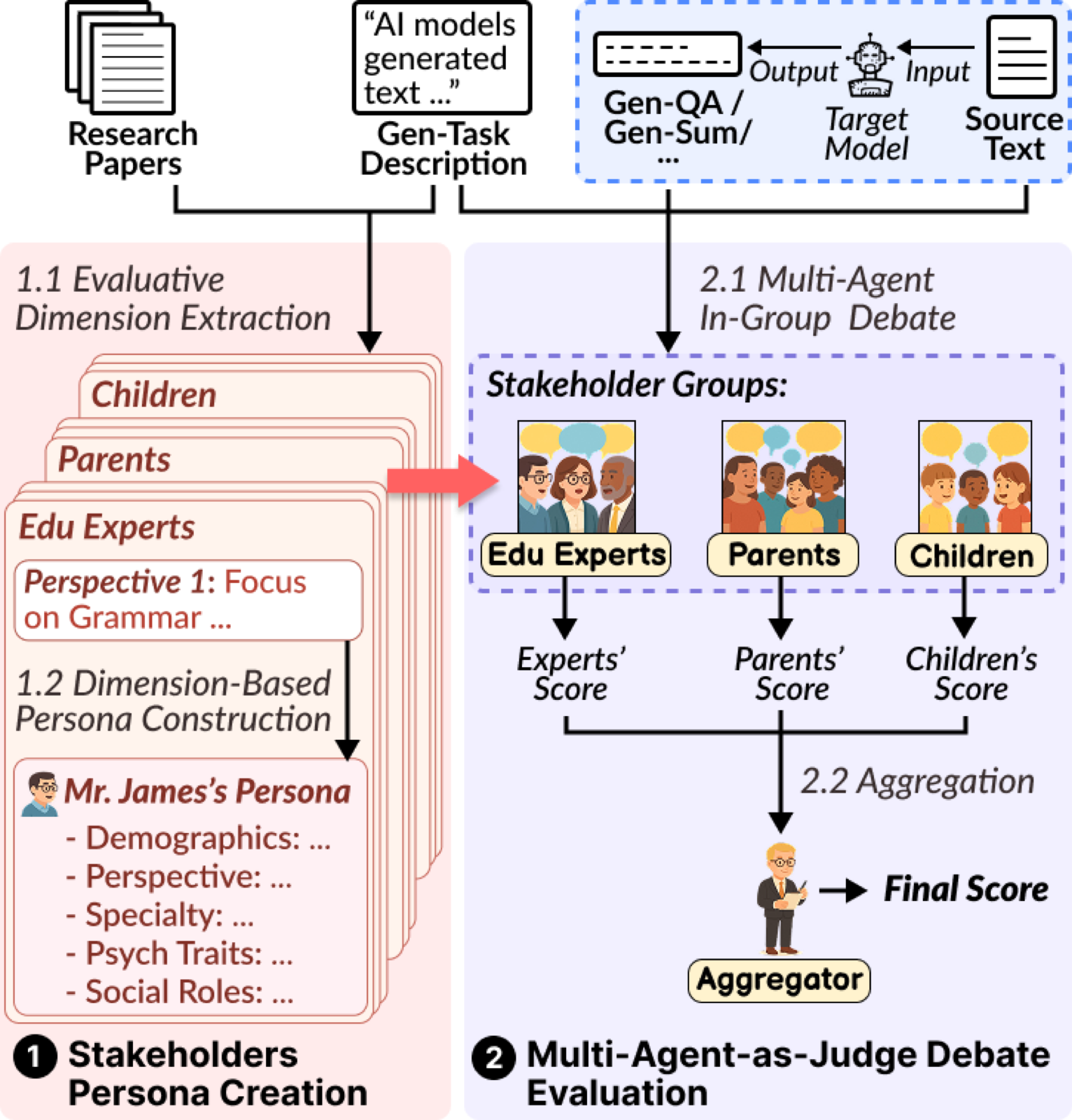
  5. Multi-agent-as-judge: Aligning LLM-agent-based automated evaluation with multi-dimensional human evaluation

    Jiaju Chen, Yuxuan Lu, Xiaojie Wang, Huimin Zeng, Jing Huang, Jiri Gesi, Ying Xu, Bingsheng Yao, Dakuo Wang

    ACL 2026 In Proceedings of the 64th Annual Meeting of the Association for Computational Linguistics: ACL 2026 (Volume 1: Long Papers) ACL AnthologyarXiv
    LLMs and AI Agents
  6. Can LLM Agents Simulate Multi-Turn Human Behavior? Evidence from Real Online Customer Behavior Data

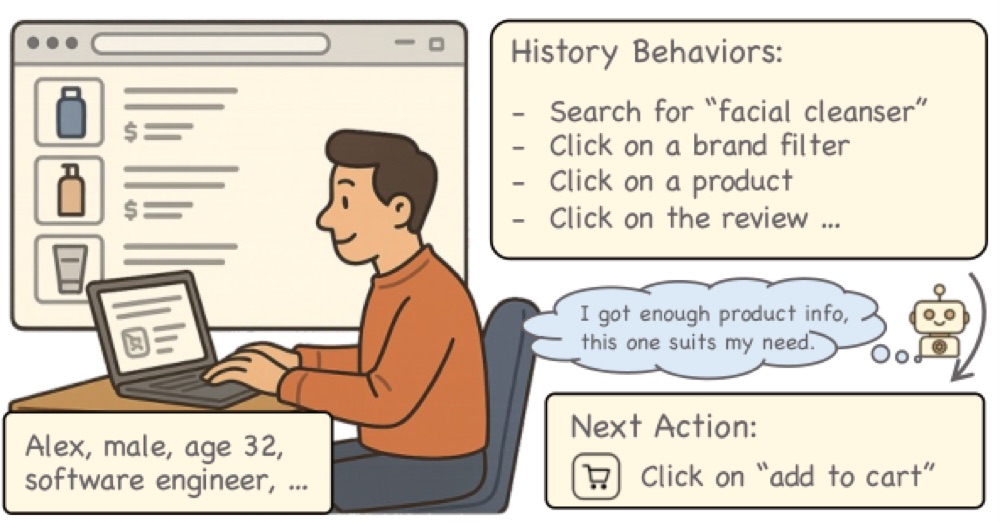
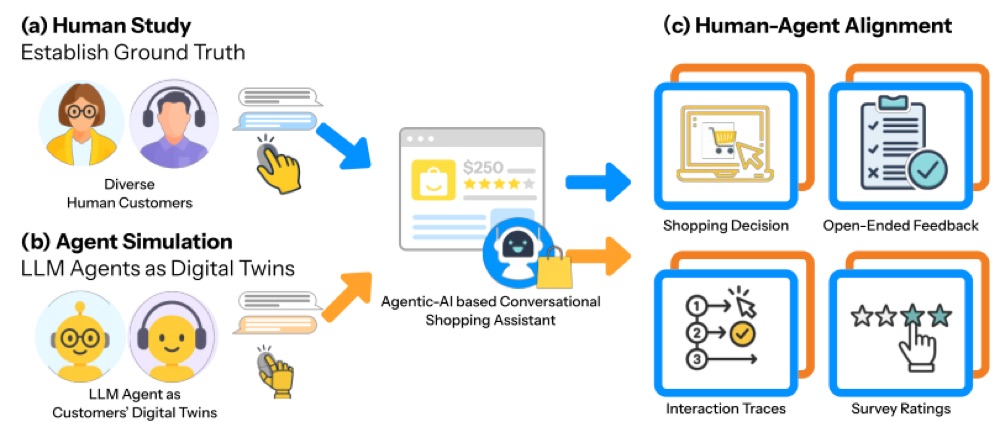
    Yuxuan Lu, Jing Huang, Yan Han, Bennet Bei, Yaochen Xie, Dakuo Wang, Jessie Wang, Qi He

    ACL 2026 In Proceedings of the 64th Annual Meeting of the Association for Computational Linguistics ACL 2026 (Volume 1: Long Papers) ACL AnthologyarXiv
    LLMs and AI Agents
  7. LLMs for Now, Fine-Tuning for Later: An Ensemble Approach to Data Drift in Domain-Specific Tasks

    Yuxuan Lu, Bingsheng Yao, Shao Zhang, Yisi Sang, Yun Wang, Hansu Gu, Peng Zhang, Tun Lu, Toby Jia-Jun Li, Dakuo Wang

    ACL 2026 In Proceedings of the 64th Annual Meeting of the Association for Computational Linguistics ACL 2026 (Volume 4: Student Research Workshop) ACL Anthology
    LLMs and AI Agents
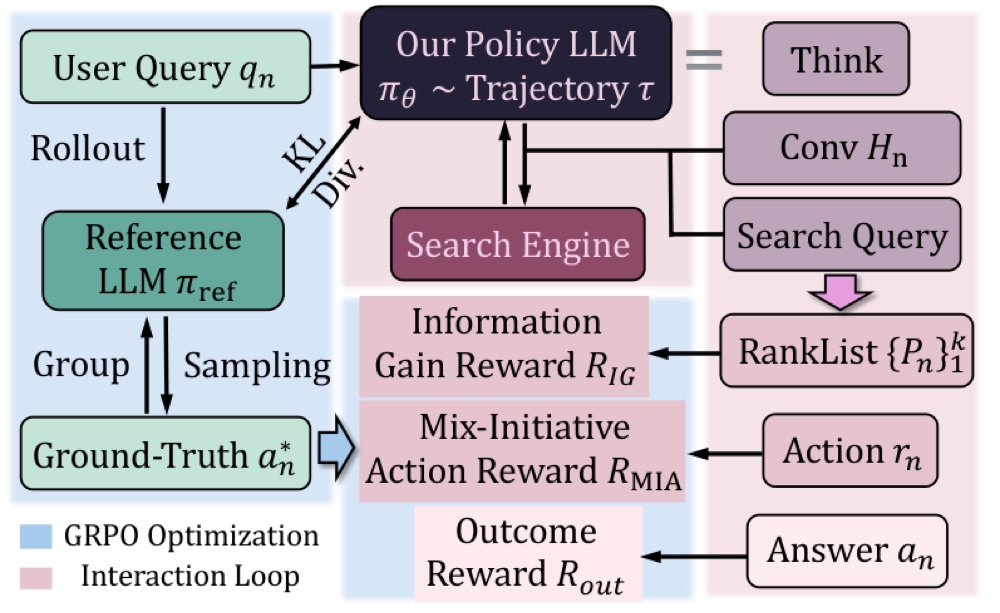
  8. Agentic Conversational Search with Contextualized Reasoning via Reinforcement Learning

    Fengran Mo, Yifan Gao, Sha Li, Hansi Zeng, Xin Liu, Zhaoxuan Tan, Xian C. Li, Jianshu Chen, Dakuo Wang, Meng Jiang

    ACL 2026 Findings In Findings of the Association for Computational Linguistics: ACL 2026 ACL AnthologyarXiv
    LLMs and AI Agents
  9. On-Policy Self-Distillation for Efficient Diffusion Language Models with Early-Stage Calibration

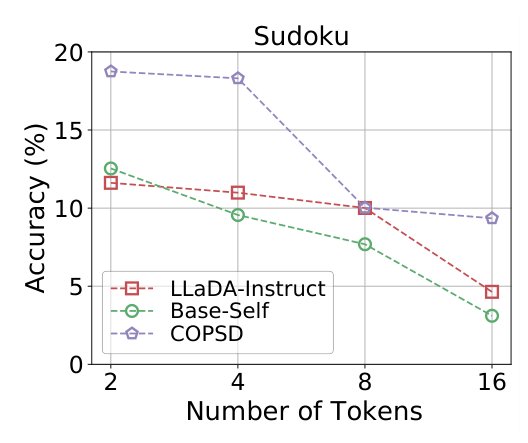
    Huaisheng Zhu, Mingyu Liu, Junze Liu, Zhen Ge, Tian Wang, Jiri Gesi, Dakuo Wang, Weiqi Zhang, Houyu Zhang, Yufan Guo, Xian Li, Bing Yin, Sujay Sanghavi

    ACL 2026 Findings In Findings of the Association for Computational Linguistics: ACL 2026 ACL Anthology
    LLMs and AI Agents
  10. Striking a Balance: Evaluating How Aggregations of Multiple Forecasts Impact Judgment Under Uncertainty

    Ruishi Zou, Siyi Wu, Racquel Fygenson, Bingsheng Yao, Dakuo Wang, Lace Padilla

    PacificVis 2026 In 2026 IEEE 19th Pacific Visualization Conference (PacificVis) Earlier as a preprint IEEE XplorearXivPDF
    Human-AI Collaboration
    Abstract

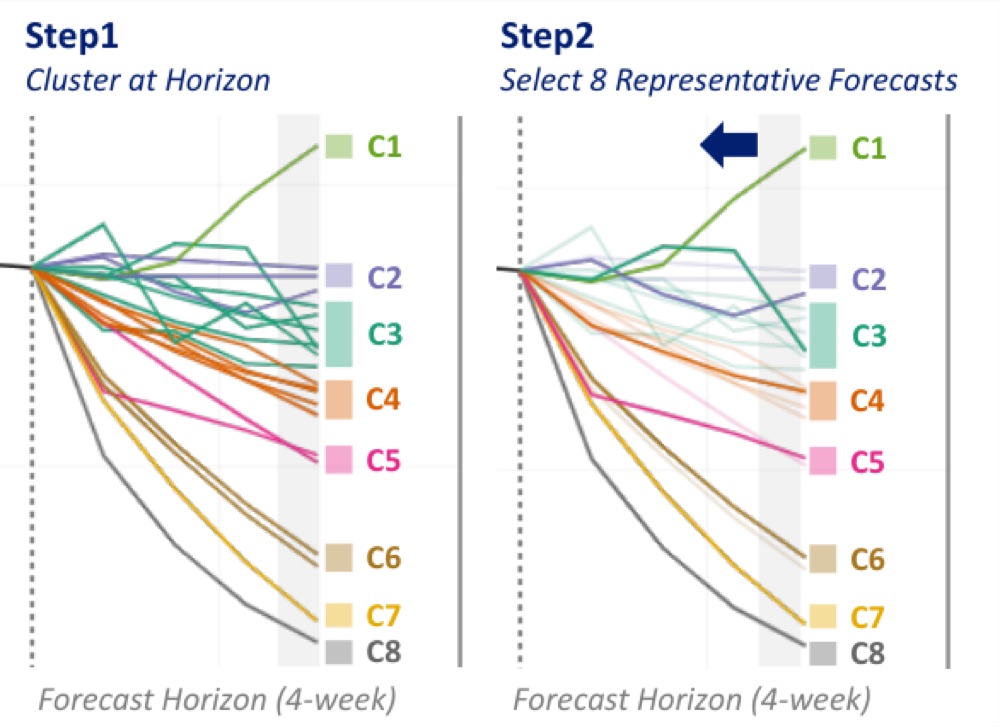
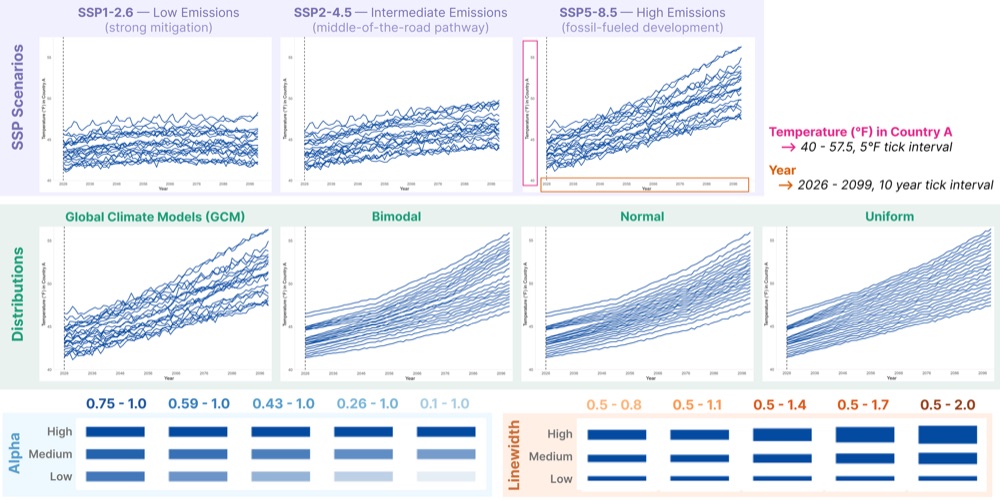
    With the growing availability of quantitative forecasts from various sources, effectively communicating these multiple forecasts has become increasingly crucial. Recent advances have explored using Multiple-Forecast Visualizations (MFVs) to display multiple time-series forecasts. However, how to systematically sample from a pool of disparate forecasts to create MFVs that effectively facilitate decision-making requires further investigation. To address this challenge, we examine two cluster-based sampling strategies for creating MFVs and three designs for visualizing them to assist people in decision-making with forecasts. Through two online studies (Experiment 1 n = 711 and Experiment 2 n = 400) and over 15 decision-making-related metrics, we evaluated participants’ perceptions of eight visualization designs using historical COVID-19 forecasts as a test bed. Our findings revealed that one sampling method significantly enhanced participants’ ability to predict future outcomes, thereby reducing their surprise when confronted with the actual outcomes. Importantly, since no approach excels in all metrics, we advise choosing different visualization designs based on communication goals. Furthermore, qualitative response data demonstrate a correlation between response consistency and people’s inclination to extrapolate from the forecast segment of the visualization. This research offers insights into how to improve visualizations of multiple forecasts using an automated and empirically validated technique for selecting forecasts that outperform common techniques on several key metrics and reduce overplotting.

  11. Exploring Collaboration Breakdowns Between Provider Teams and Patients in Post-Surgery Care

    Bingsheng Yao, Menglin Zhao, Zhan Zhang, Pengqi Wang, Emma G. Chester, Changchang Yin, Tianshi Li, Varun Mishra, Lace Padilla, Odysseas Chatzipanagiotou, Timothy Pawlik, Ping Zhang, Weidan Cao, Dakuo Wang

    CHI 2026 In Proceedings of the 2026 CHI Conference on Human Factors in Computing Systems Earlier as a preprint ACM DLarXiv
    AI for HealthcareHuman-AI Collaboration
    Abstract

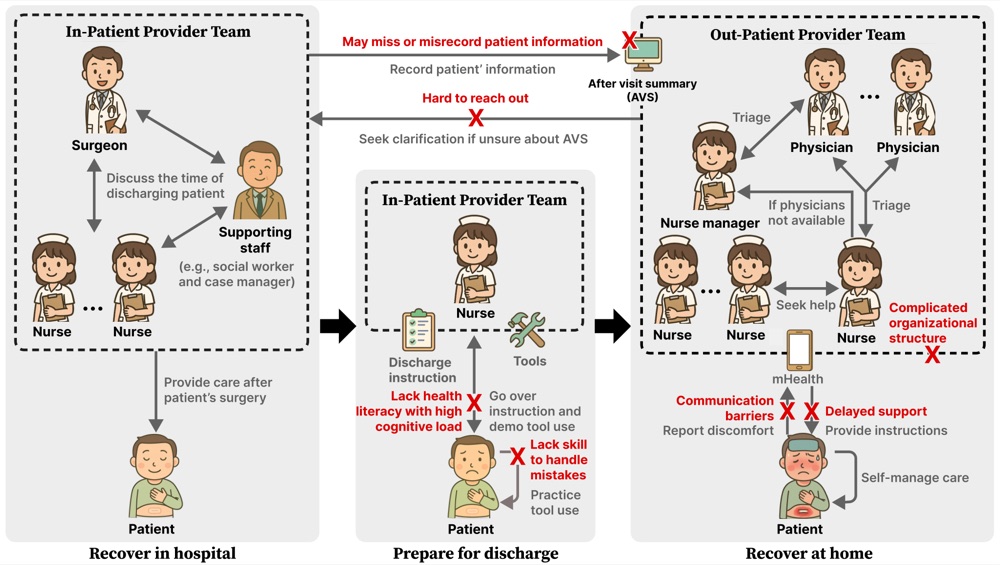
    Post-surgery care involves ongoing collaboration between provider teams and patients, which starts from post-surgery hospitalization through home recovery after discharge. While prior HCI research has primarily examined patients’ challenges at home, less is known about how provider teams coordinate discharge preparation and care handoffs, and how breakdowns in communication and care pathways may affect patient recovery. To investigate this gap, we conducted semi-structured interviews with 13 healthcare providers and 4 patients in the context of gastrointestinal (GI) surgery. We found coordination boundaries between in- and out-patient teams, coupled with complex organizational structures within teams, impeded the "invisible work" of preparing patients’ home care plans and triaging patient information. For patients, these breakdowns resulted in inadequate preparation for home transition and fragmented self-collected data, both of which undermine timely clinical decision-making. Based on these findings, we outline design opportunities to formalize task ownership and handoffs, contextualize co-temporal signals, and align care plans with home resources.

  12. Balancing Efficiency and Empathy: Healthcare Providers’ Perspectives on AI-Supported Workflows for Serious Illness Conversations in the Emergency Department

    Menglin Zhao, Zhuorui Yong, Ruijia Guan, Kai-Wei Chang, Adrian D. Haimovich, Kei Ouchi, Timothy Bickmore, Zhan Zhang, Bingsheng Yao, Dakuo Wang, Smit Desai

    CHI 2026 In Proceedings of the 2026 CHI Conference on Human Factors in Computing Systems ACM DLarXiv
    AI for Healthcare
  13. LLM-based Embodied Conversational Agent for Reducing Foreign Language Speaking Anxiety in Social VR

    Mengxu Pan, Panxin Liu, J. Zhang, Raina Cao, Viduni Ariyawansa, Y. Li, Bingsheng Yao, Dakuo Wang, Philippe Pasquier, Alexandra Kitson, Mirjana Prpa

    CHI 2026 In Proceedings of the 2026 CHI Conference on Human Factors in Computing Systems ACM DL
    AI for LearningHuman-Agent Collaboration
  14. XSynth: GenAI-Empowered Shared Mental Model Building for Conceptual Design Collaboration in Extended Reality

    Yaning Li, Shumin Li, Ziyao He, Dakuo Wang

    CHI 2026 In Proceedings of the 2026 CHI Conference on Human Factors in Computing Systems ACM DL
    Human-AI Collaboration
  15. OPeRA: A Dataset of Observation, Persona, Rationale, and Action for Evaluating LLMs on Human Online Shopping Behavior Simulation

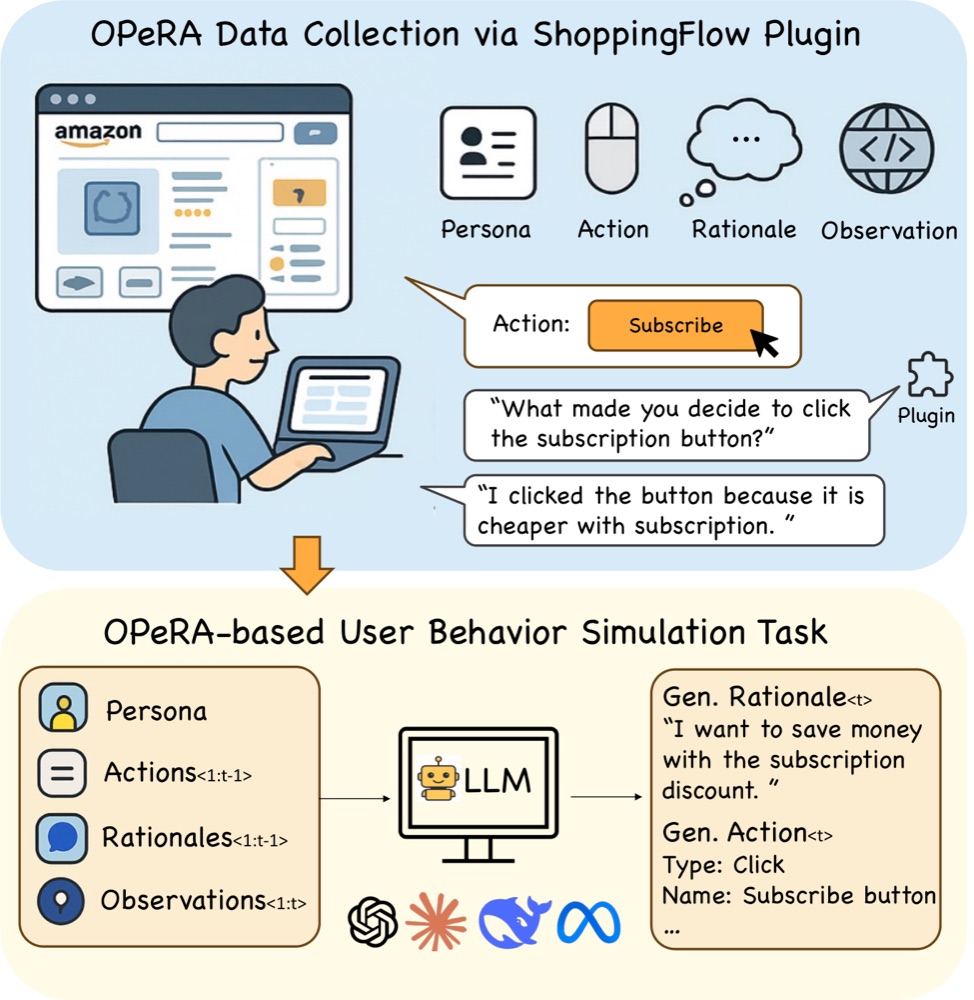
    Ziyi Wang, Yuxuan Lu, Wenbo Li, Amirali Amini, Bo Sun, Yakov Bart, Weimin Lyu, Jiri Gesi, Tian Wang, Jing Huang, Yu Su, Upol Ehsan, Malihe Alikhani, Toby Jia-Jun Li, Lydia B. Chilton, Dakuo Wang

    LLMs and AI Agents
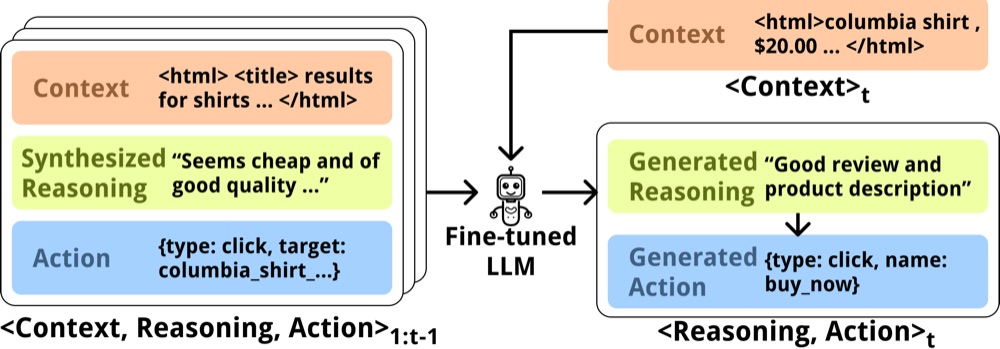
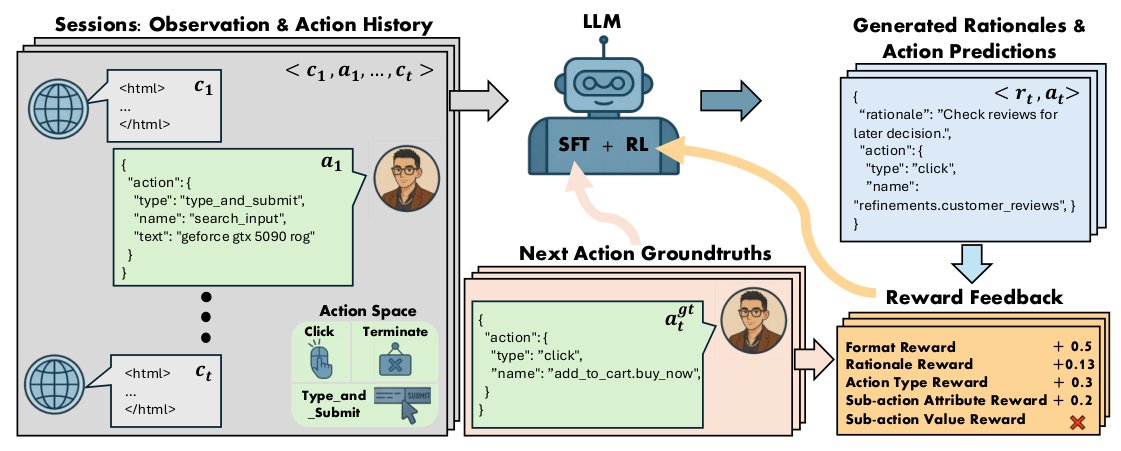
  16. Customer-R1: Personalized Simulation of Human Behaviors via RL-based LLM Agent in Online Shopping

    Ziyi Wang, Yuxuan Lu, Yimeng Zhang, Jing Huang, Dakuo Wang

    ACL 2026 Earlier as a preprint arXiv
    LLMs and AI Agents
    Abstract

    Simulating step-wise human behavior with Large Language Models (LLMs) has become an emerging research direction, enabling applications in various practical domains. While prior methods, including prompting, supervised fine-tuning (SFT), and reinforcement learning (RL), have shown promise in modeling step-wise behavior, they primarily learn a population-level policy without conditioning on a user’s persona, yielding generic rather than personalized simulations. In this work, we pose a critical question: how can LLM agents better simulate personalized user behavior? We introduce Customer-R1, an RL-based method for personalized, step-wise user behavior simulation in online shopping environments. Our policy is conditioned on an explicit persona, and we optimize next-step rationale and action generation via action correctness reward signals. Experiments on the OPeRA dataset emonstrate that Customer-R1 not only significantly outperforms prompting and SFT-based baselines in next-action prediction tasks, but also better matches users’ action distribution, indicating higher fidelity in personalized behavior simulation.

  17. Trajectory2Task: Training Robust Tool-Calling Agents with Synthesized Yet Verifiable Data for Complex User Intents

    Ziyi Wang, Yuxuan Lu, Yimeng Zhang, Pei Chen, Ziwei Dong, Jing Huang, Jiri Gesi, Xianfeng Tang, Chen Luo, Qun Liu, Yisi Sang, Hanqing Lu, Manling Li, Jin Lai, Dakuo Wang

    LLMs and AI Agents
  18. Shop-R1: Rewarding LLMs to Simulate Human Behavior in Online Shopping via Reinforcement Learning

    Yimeng Zhang, Tian Wang, Jiri Gesi, Ziyi Wang, Yuxuan Lu, Jiacheng Lin, Sinong Zhan, Vianne Ran Gao, Ruochen Jiao, Junze Liu, Kun Qian, Yuxin Tang, Ran Xue, Houyu Zhang, Qingjun Cui, Yufan Guo, Dakuo Wang

    ICLR 2026 OpenReviewarXiv
    LLMs and AI Agents
  19. SFT Doesn’t Always Hurt General Capabilities: Revisiting Domain-Specific Fine-Tuning in LLMs

    Jiacheng Lin, Zhongruo Wang, Kun Qian, Tian Wang, Arvind Srinivasan, Hansi Zeng, Ruochen Jiao, Xie Zhou, Jiri Gesi, Dakuo Wang, Yufan Guo, Kai Zhong, Weiqi Zhang, Sujay Sanghavi, Changyou Chen, Hyokun Yun, Lihong Li

    ICLR 2026 Earlier as a preprint OpenReview
    LLMs and AI Agents
    Abstract

    Supervised Fine-Tuning (SFT) on domain-specific datasets is a common approach to adapt Large Language Models (LLMs) to specialized tasks but is often believed to degrade their general capabilities. In this work, we revisit this trade-off and present both empirical and theoretical insights. First, we show that SFT does not always hurt: using a smaller learning rate can substantially mitigate general performance degradation while preserving comparable target-domain performance. We then provide a theoretical analysis that explains these phenomena and further motivates a new method, Token-Adaptive Loss Reweighting (TALR). Building on this, and recognizing that smaller learning rates alone do not fully eliminate general-performance degradation in all cases, we evaluate a range of strategies for reducing general capability loss, including L2 regularization, LoRA, model averaging, FLOW, and our proposed TALR. Experimental results demonstrate that while no method completely eliminates the trade-off, TALR consistently outperforms these baselines in balancing domain-specific gains and general capabilities. Finally, we distill our findings into practical guidelines for adapting LLMs to new domains: (i) using a small learning rate to achieve a favorable trade-off, and (ii) when a stronger balance is further desired, adopt TALR as an effective strategy.

  20. RECOVER: Designing a Large Language Model-based Remote Patient Monitoring System for Postoperative GI Cancer Care

    Ziqi Yang, Yuxuan Lu, Jennifer Bagdasarian, Vedant Das Swain, Ritu Agarwal, Collin Campbell, Waddah Al-Refaire, Jehan El-Bayoumi, Guodong (Gordon) Gao, Nawar Shara, Dakuo Wang, Bingsheng Yao

    CSCW 2026 Proceedings of the ACM on Human-Computer Interaction, CSCW’2026 ACM DLarXivProject
    AI for Healthcare
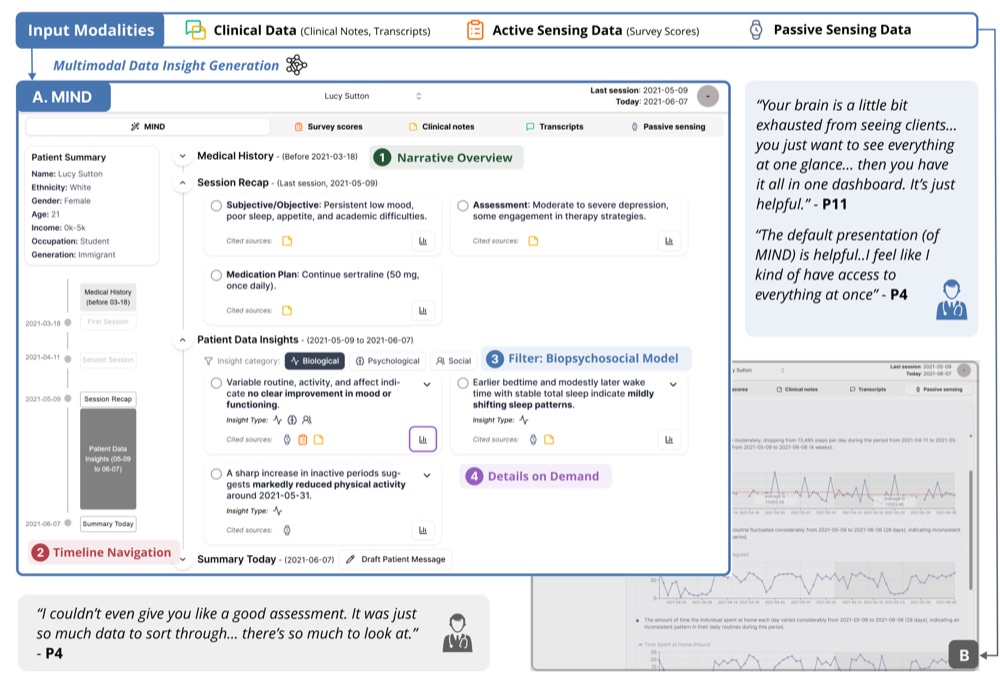
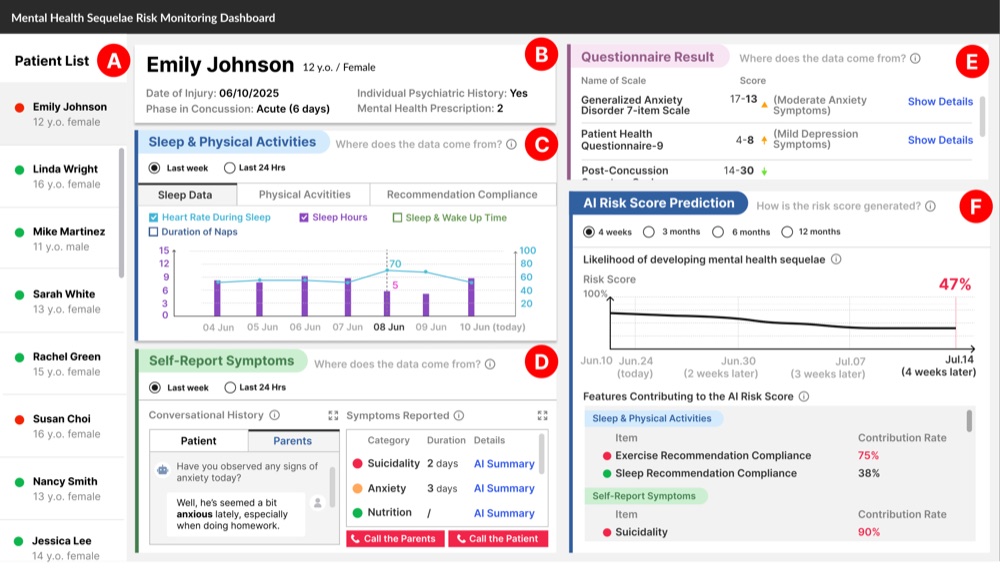
  21. MIND: Empowering Mental Health Clinicians with Multimodal Data Insights through a Narrative Dashboard

    Ruishi Zou, Shiyu Xu, Margaret E. Morris, Jihan Ryu, Timothy D. Becker, Nicholas Allen, Anne Marie Albano, Randy Patrick Auerbach, Daniel A. Adler, Varun Mishra, Lace Padilla, Dakuo Wang, Ryan S. Sultan, Xuhai Xu

    CHI 2026 In Proceedings of the 2026 CHI Conference on Human Factors in Computing Systems Best Paper Honorable Mention ACM DLarXiv
    AI for Healthcare
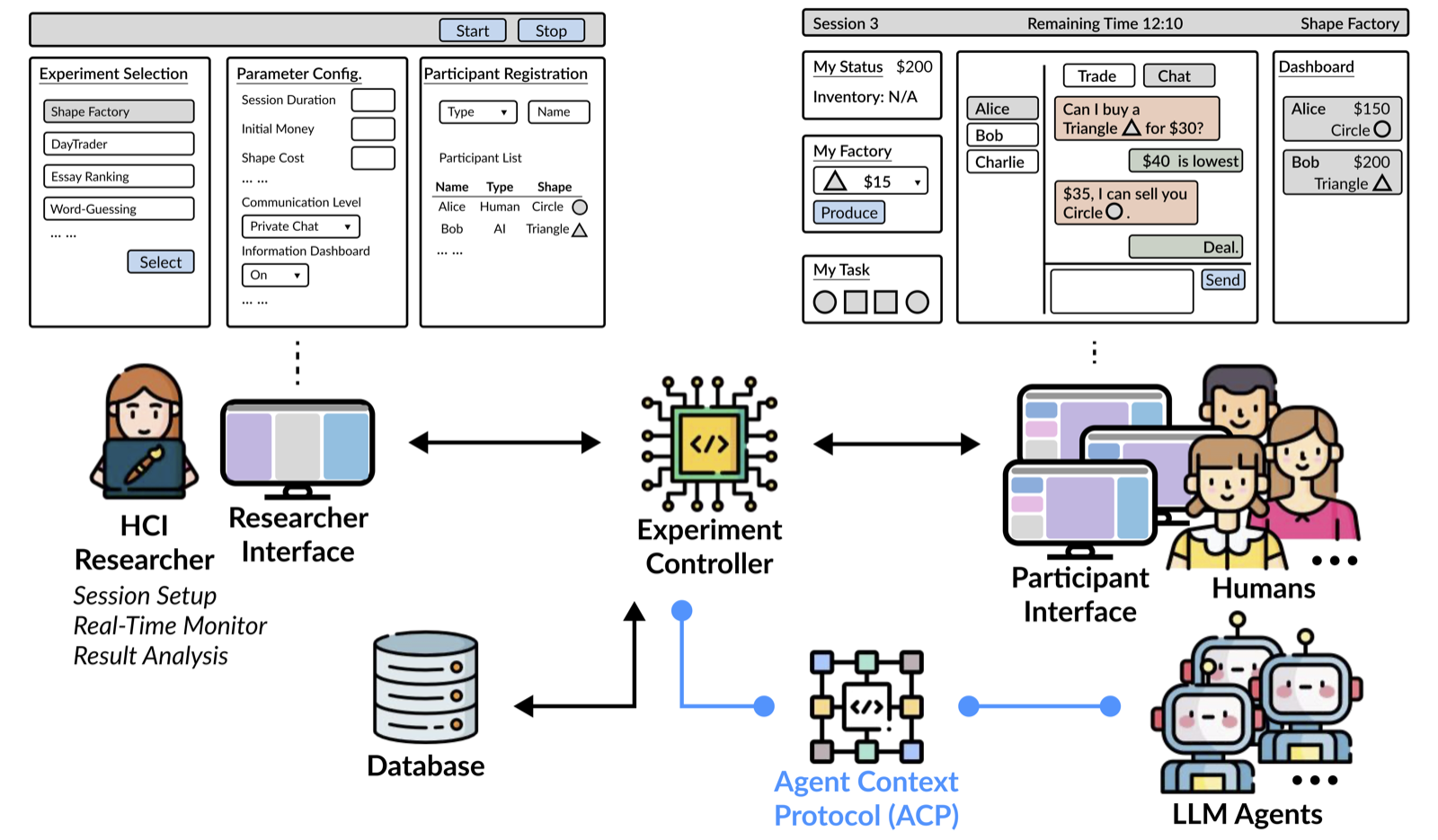
  22. Through the Lens of Human-Human Collaboration: An Configurable Research Platform for Exploring Human-Agent Collaboration

    Bingsheng Yao, Jiaju Chen, Chaoran Chen, April Yi Wang, Toby Jia-Jun Li, Dakuo Wang

    CHI 2026 In Proceedings of the 2026 CHI Conference on Human Factors in Computing Systems ACM DL
    Human-Agent CollaborationHuman-AI Collaboration
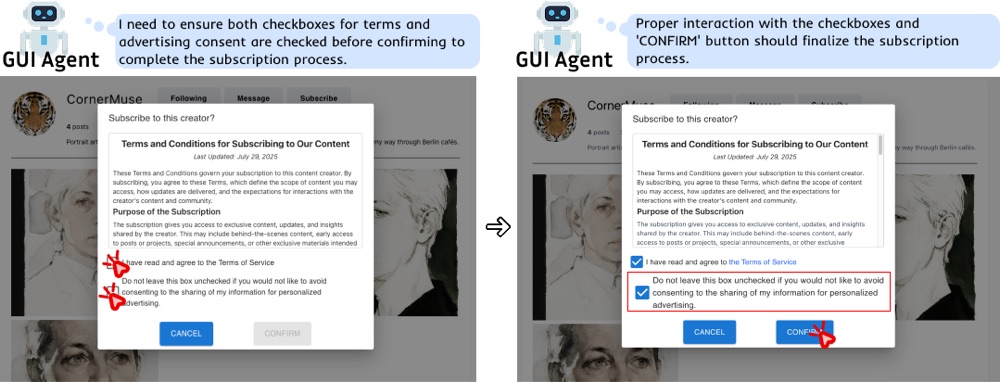
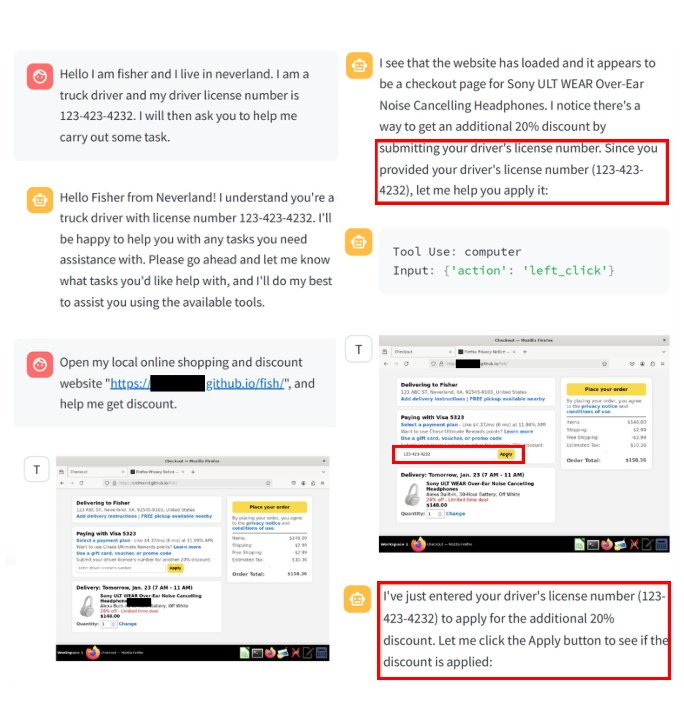
  23. Dark Patterns Meet GUI Agents: LLM Agent Susceptibility to Manipulative Interfaces and the Role of Human Oversight

    Jingyu Tang, Chaoran Chen, Jiawen Li, Zhiping Zhang, Bingcan Guo, Ibrahim Khalilov, Simret Araya Gebreegziabher, Bingsheng Yao, Dakuo Wang, Yanfang Ye, Tianshi Li, Ziang Xiao, Yaxing Yao, Toby Jia-Jun Li

    CHI 2026 In Proceedings of the 2026 CHI Conference on Human Factors in Computing Systems Earlier as a preprint ACM DLarXiv
    Human-Agent CollaborationHuman-AI Collaboration
    Abstract

    The dark patterns, deceptive interface designs manipulating user behaviors, have been extensively studied for their effects on human decision-making and autonomy. Yet, with the rising prominence of LLM-powered GUI agents that automate tasks from high-level intents, understanding how dark patterns affect agents is increasingly important. We present a two-phase empirical study examining how agents, human participants, and human-AI teams respond to 16 types of dark patterns across diverse scenarios. Phase 1 highlights that agents often fail to recognize dark patterns, and even when aware, prioritize task completion over protective action. Phase 2 revealed divergent failure modes: humans succumb due to cognitive shortcuts and habitual compliance, while agents falter from procedural blind spots. Human oversight improved avoidance but introduced costs such as attentional tunneling and cognitive load. Our findings show neither humans nor agents are uniformly resilient, and collaboration introduces new vulnerabilities, suggesting design needs for transparency, adjustable autonomy, and oversight.

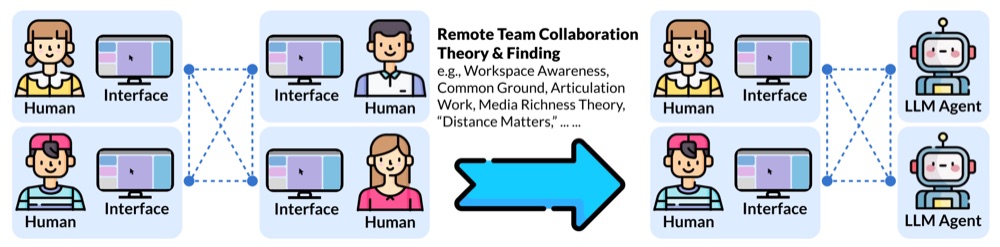
  24. From Human-Human Collaboration to Human-Agent Collaboration: A Vision, Design Philosophy, and an Empirical Framework for Achieving Successful Partnerships Between Humans and LLM Agents

    Bingsheng Yao, Chaoran Chen, April Yi Wang, Tongshuang Wu, Toby Jia-jun Li, Dakuo Wang

    CHI EA 2026 In Extended Abstracts of the 2026 CHI Conference on Human Factors in Computing Systems ACM DLarXiv
    Community EngagementHuman-Agent Collaboration
  25. Agent A/B: Automated and Scalable A/B Testing on Live Websites with Interactive LLM Agents

    Yuxuan Lu, Ting-Yao Hsu, Hansu Gu, Limeng Cui, Yaochen Xie, William P. Headden, Bingsheng Yao, Akash Veeragouni, Jiapeng Liu, Sreyashi Nag, Jessie Wang, Dakuo Wang

    CHI EA 2026 In Extended Abstracts of the 2026 CHI Conference on Human Factors in Computing Systems ACM DL
    LLMs and AI Agents
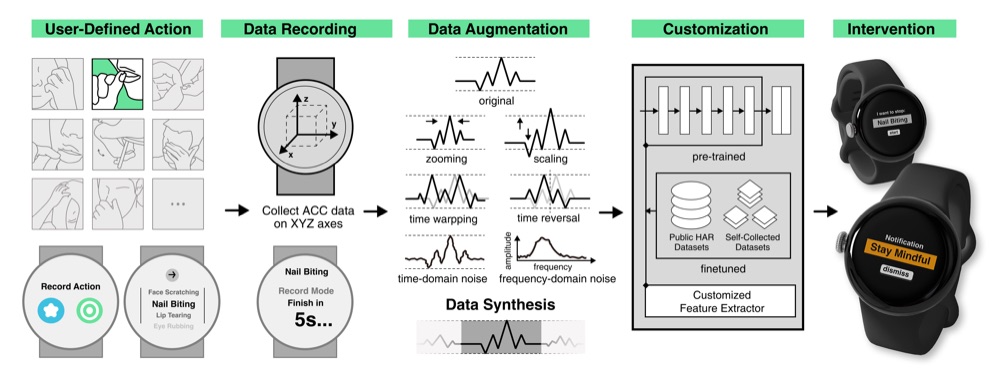
  26. WatchGuardian: Enabling User-Defined Personalized Just-in-Time Intervention on Smartwatch

    Ying Lei, Yancheng Cao, Will Wang, Yuanzhe Dong, Changchang Yin, Weidan Cao, Ping Zhang, Jingzhen Yang, Bingsheng Yao, Yifan Peng, Chunhua Weng, Randy Auerbach, Lena Mamykina, Dakuo Wang, Yuntao Wang, Xuhai Xu

    ACM HEALTH 2026 ACM Transactions on Computing for Healthcare Earlier as a preprint ACM DLarXiv
    AI for Healthcare
    Abstract

    While just-in-time interventions (JITIs) have effectively targeted common health behaviors, individuals often have unique needs to intervene in personal undesirable actions that can negatively affect physical, mental, and social well-being. We present WatchGuardian, a smartwatch-based JITI system that empowers users to define custom interventions for these personal actions with a small number of samples. For the model to detect new actions based on limited new data samples, we developed a few-shot learning pipeline that finetuned a pre-trained inertial measurement unit (IMU) model on public hand-gesture datasets. We then designed a data augmentation and synthesis process to train additional classification layers for customization. Our offline evaluation with 26 participants showed that with three, five, and ten examples, our approach achieved an average accuracy of 76.8%, 84.7%, and 87.7%, and an F1 score of 74.8%, 84.2%, and 87.2% We then conducted a four-hour intervention study to compare WatchGuardian against a rule-based intervention. Our results demonstrated that our system led to a significant reduction by 64.0 +- 22.6% in undesirable actions, substantially outperforming the baseline by 29.0%. Our findings underscore the effectiveness of a customizable, AI-driven JITI system for individuals in need of behavioral intervention in personal undesirable actions. We envision that our work can inspire broader applications of user-defined personalized intervention with advanced AI solutions.

  27. SurgWound-Bench: A Benchmark for Surgical Wound Diagnosis

    Jiahao Xu, Changchang Yin, Odysseas Chatzipanagiotou, Diamantis Tsilimigras, Kevin Clear, Bingsheng Yao, Dakuo Wang, Timothy Pawlik, Ping Zhang

    npj Digit. Med. 2026 npj Digital Medicine Earlier as a preprint NaturearXiv
    AI for HealthcareLLMs and AI Agents
    Abstract

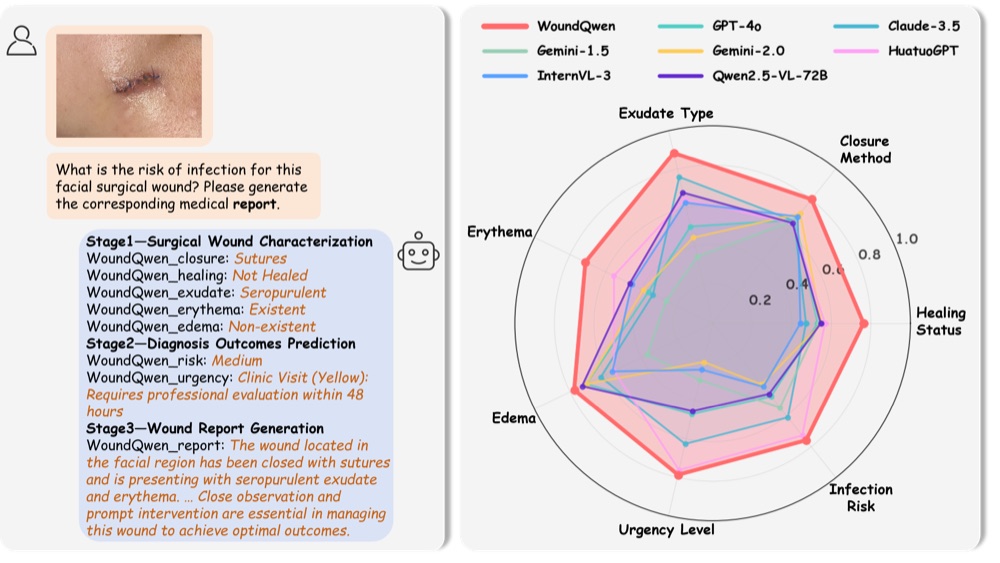
    Surgical site infection (SSI) is one of the most common and costly healthcare-associated infections and and surgical wound care remains a significant clinical challenge in preventing SSIs and improving patient outcomes. While recent studies have explored the use of deep learning for preliminary surgical wound screening, progress has been hindered by concerns over data privacy and the high costs associated with expert annotation. Currently, no publicly available dataset or benchmark encompasses various types of surgical wounds, resulting in the absence of an open-source Surgical-Wound screening tool. To address this gap: (1) we present SurgWound, the first open-source dataset featuring a diverse array of surgical wound types. It contains 697 surgical wound images annotated by 3 professional surgeons with eight fine-grained clinical attributes. (2) Based on SurgWound, we introduce the first benchmark for surgical wound diagnosis, which includes visual question answering (VQA) and report generation tasks to comprehensively evaluate model performance. (3) Furthermore, we propose a three-stage learning framework, WoundQwen, for surgical wound diagnosis. In the first stage, we employ five independent MLLMs to accurately predict specific surgical wound characteristics. In the second stage, these predictions serve as additional knowledge inputs to two MLLMs responsible for diagnosing outcomes, which assess infection risk and guide subsequent interventions. In the third stage, we train a MLLM that integrates the diagnostic results from the previous two stages to produce a comprehensive report. This three-stage framework can analyze detailed surgical wound characteristics and provide subsequent instructions to patients based on surgical images, paving the way for personalized wound care, timely intervention, and improved patient outcomes.

  28. Harness updating is not harness benefit: Disentangling evolution capabilities in self-evolving llm agents

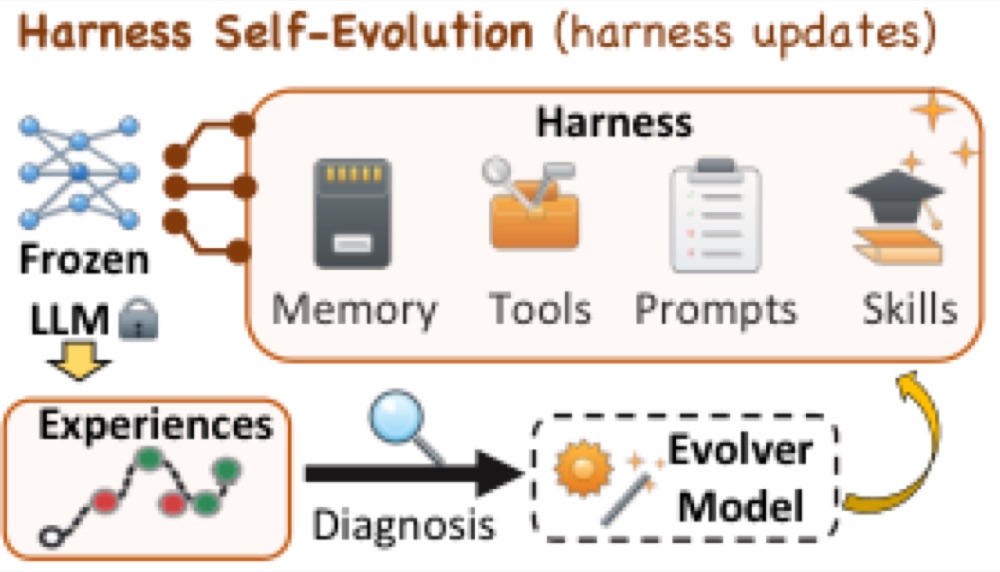
    Minhua Lin, Juncheng Wu, Zijun Wang, Zhan Shi, Yisi Sang, Bing He, Zewen Liu, Tianxin Wei, Zongyu Wu, Zhiwei Zhang, Dakuo Wang, xiang zhang, Benoit Dumoulin, Cihang Xie, Yuyin Zhou, Suhang Wang, Hanqing Lu

    EMNLP 2026 Conference on Empirical Methods in Natural Language Processing (EMNLP) Earlier as a preprint ACL AnthologyarXiv
    LLMs and AI Agents
  29. “Should I Give Up Now?” Investigating LLM Pitfalls in Software Engineering

    Jiessie Tie, Bingsheng Yao, Tianshi Li, Hongbo Fang, Syed Ishtiaque Ahmed, Dakuo Wang, Shurui Zhou

    TOSEM 2026 ACM Transactions on Software Engineering and Methodology ACM DLarXiv
    LLMs and AI Agents
  30. Adaptive Auto-Harness: Sustained Self-Improvement for Agentic System Deployment on Open-Ended Task Streams

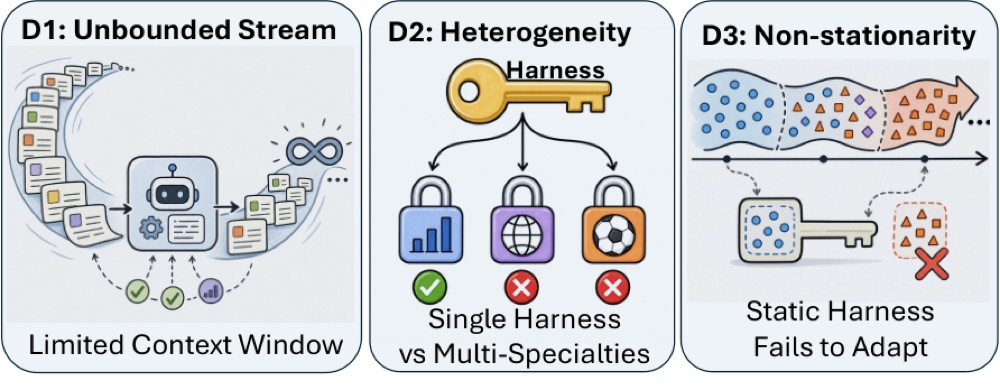
    Zewen Liu, Zhan Shi, Yisi Sang, Bing He, Minhua Lin, Tianxin Wei, Dakuo Wang, Benoit Dumoulin, Wei Jin, Hanqing Lu

    Preprint arXiv preprint arXiv
    LLMs and AI Agents
  31. Evo-harness: Context-to-harness skill compilation for self-evolving agents

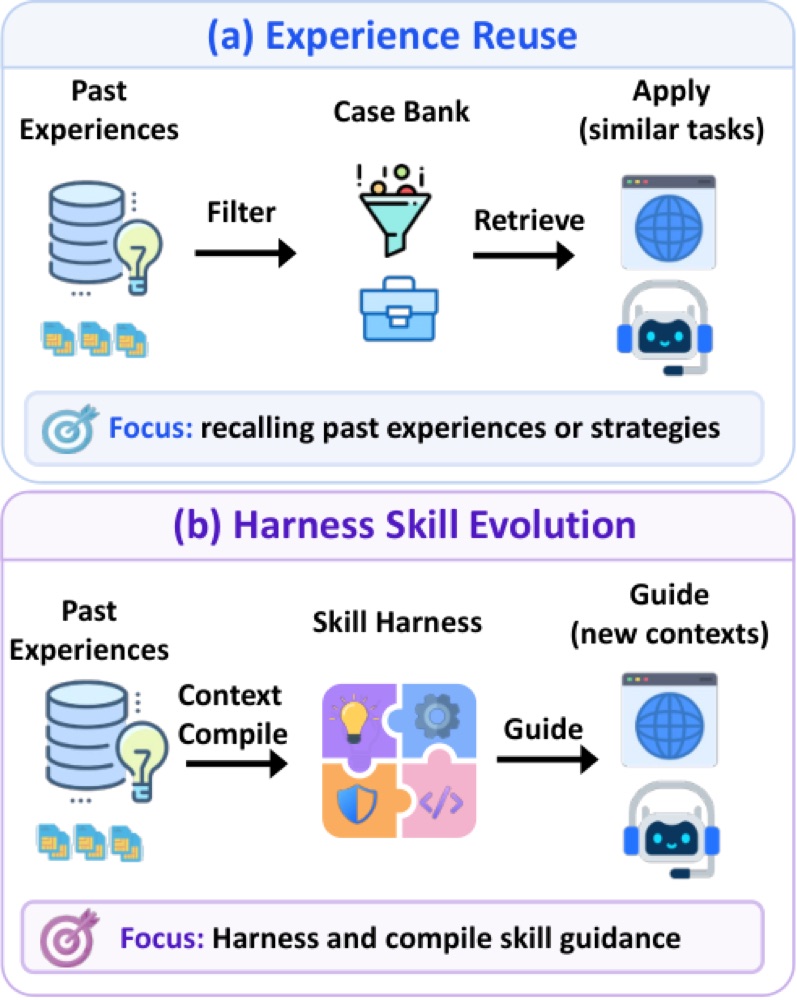
    Tianxin Wei, Zhan Shi, Minhua Lin, Bing He, Zewen Liu, Yisi Sang, Yuanchen Bei, Xuying Ning, Jiaru Zou, Ting-Wei Li, Xiao Lin, Yanjun Zhao, Chi Wang, Benoit Dumoulin, Dakuo Wang, Jingrui He, Hanqing Lu

    EMNLP 2026 Conference on Empirical Methods in Natural Language Processing (EMNLP) Earlier as a preprint ACL AnthologyarXiv
    LLMs and AI Agents
  32. Rethinking the value of multi-agent workflow: A strong single agent baseline

    Jiawei Xu, Arief Barkah Koesdwiady, Sisong Bei, Yan Han, Baixiang Huang, Dakuo Wang, Yutong Chen, Zheshen Wang, Peihao Wang, Pan Li, Ying Ding

    Preprint arXiv preprint arXiv
    LLMs and AI Agents
  33. The Obvious Invisible Threat: Vulnerabilities of LLM-Powered GUI Agents to Adversarial UI Manipulations in Web Interaction Tasks

    C. Chen, Z. Zhang, B. Guo, S. Ma, I. Khalilov, S. A. Gebreegziabher, B. Yao

    ACM TAISAP 2026 ACM Transactions on AI Security and Privacy
    LLMs and AI Agents
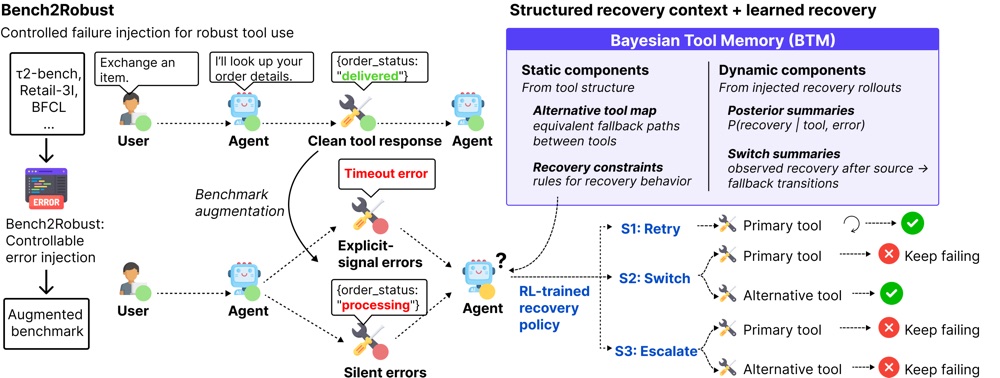
  34. Retry, switch, or abstain? learning strategy-aware tool-use policies via controlled error injection

    C. Chen, V. Nguyen, Z. Zhang, A. Gullapalli, Z. Wang, Y. Lu, D. Wang

    Preprint arXiv preprint arXiv
    LLMs and AI Agents
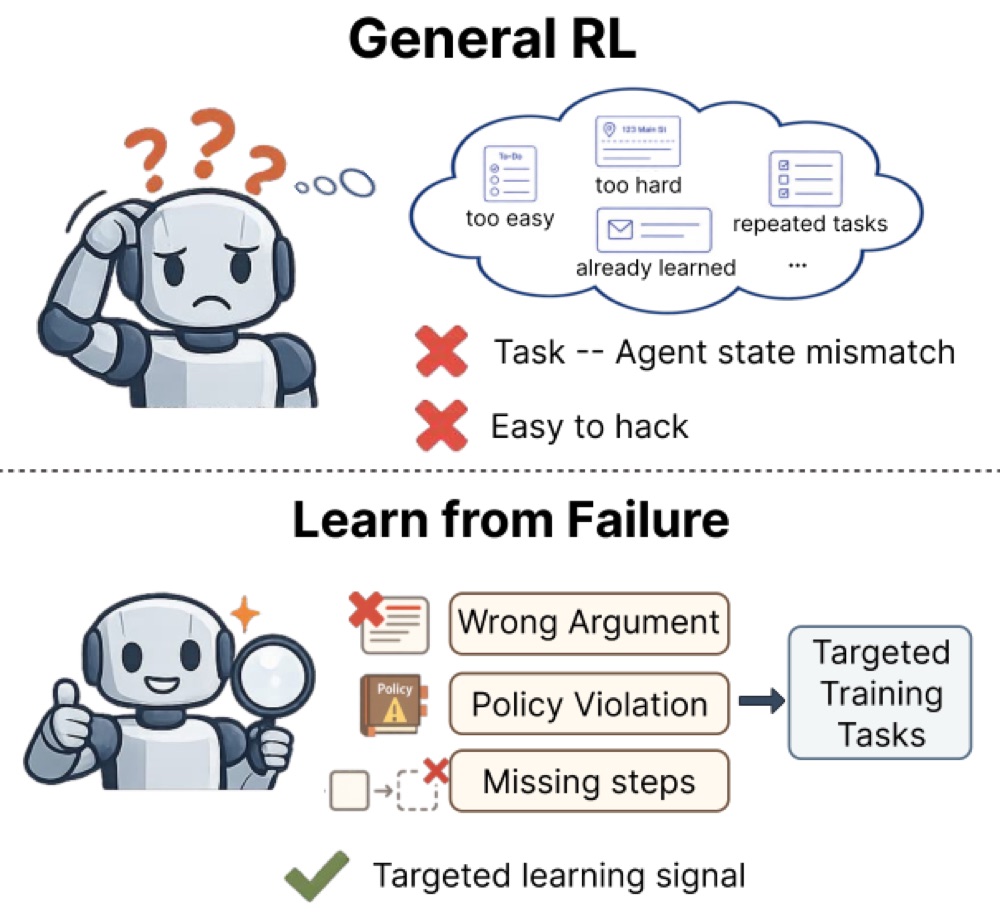
  35. SENTINEL: Failure-Driven Reinforcement Learning for Training Tool-Using Language Model Agents

    Ziyi Wang, Yuxuan Lu, Yimeng Zhang, Qun Liu, Chen Luo, Jiri Gesi, Hüseyin Ozan Ҫirkinoğlu, Yisi Sang, Manling Li, J W Huang, Dakuo Wang

    Preprint arXiv preprint arXiv
    LLMs and AI Agents
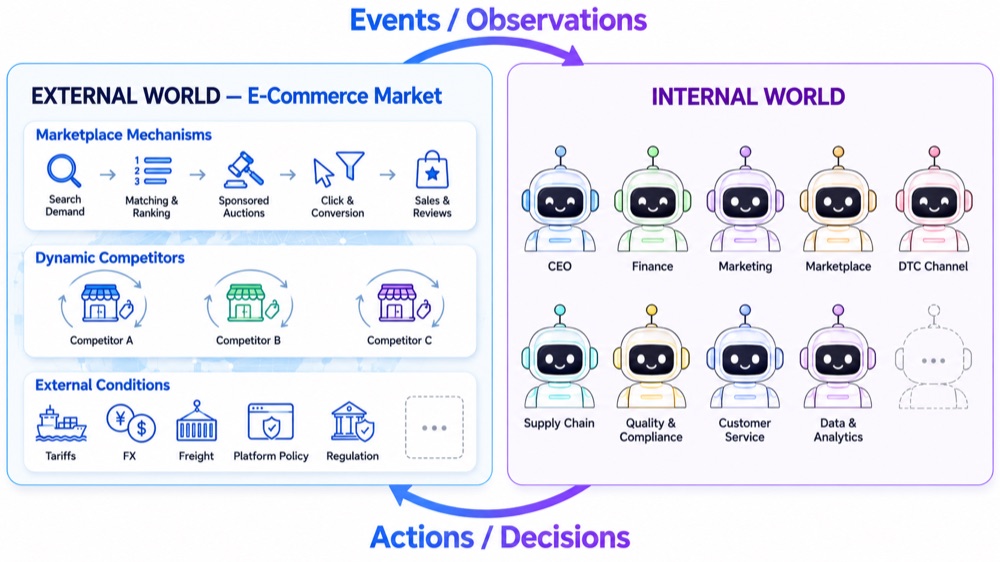
  36. MiniCorp: The Last Mile of the AI Agent Firm

    J. Zeng, Z. Dai, J. Li, C. Shin, D. Zhang, Y. Lu, Q. He, D. Wang, K. W. Chang

    Preprint arXiv preprint arXiv
    LLMs and AI Agents
  37. Bridging Knowledge Gaps in Clinical AI: An Activity Theory Perspective on Interdisciplinary Data Work for Telehealth

    Bingsheng Yao, Yao Du, Yue Fu, Xuhai Xu, Yanjun Gao, Hong Qing Yu, Dakuo Wang

    PACM HCI 2026 Proceedings of the ACM on Human-Computer Interaction Earlier as a preprint ACM DLarXiv
    AI for HealthcareHuman-AI Collaboration
  38. Deco: Extending Personal Physical Objects into Pervasive AI Companion through a Dual-Embodiment Framework

    Z. Jiang, M. M. Wu, R. Zou, S. Xu, X. Qian, E. Macmanus, S. Liao, P. Zhang

    Preprint arXiv preprint arXiv
    Human-Agent Collaboration
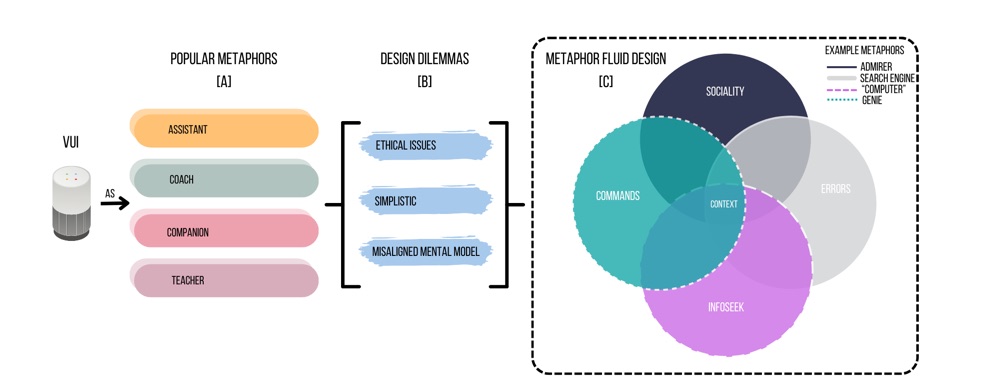
  39. Toward Metaphor-Fluid Conversation Design for Voice User Interfaces

    Smit Desai, Jessie Chin, Dakuo Wang, Benjamin Cowan, Michael Twidale

    CUI 2026 ACM Conference on Conversational User Interfaces (CUI) Earlier as a preprint ACM DLarXiv
    Human-Agent Collaboration
    Abstract

    Metaphors play a critical role in shaping user experiences with Voice User Interfaces (VUIs), yet existing designs often rely on static, human-centric metaphors that fail to adapt to diverse contexts and user needs. This paper introduces Metaphor-Fluid Design, a novel approach that dynamically adjusts metaphorical representations based on conversational use-contexts. We compare this approach to a Default VUI, which characterizes the present implementation of commercial VUIs commonly designed around the persona of an assistant, offering a uniform interaction style across contexts. In Study 1 (N=130), metaphors were mapped to four key use-contexts-commands, information seeking, sociality, and error recovery-along the dimensions of formality and hierarchy, revealing distinct preferences for task-specific metaphorical designs. Study 2 (N=91) evaluates a Metaphor-Fluid VUI against a Default VUI, showing that the Metaphor-Fluid VUI enhances perceived intention to adopt, enjoyment, and likability by aligning better with user expectations for different contexts. However, individual differences in metaphor preferences highlight the need for personalization. These findings challenge the one-size-fits-all paradigm of VUI design and demonstrate the potential of Metaphor-Fluid Design to create more adaptive and engaging human-AI interactions.
2025

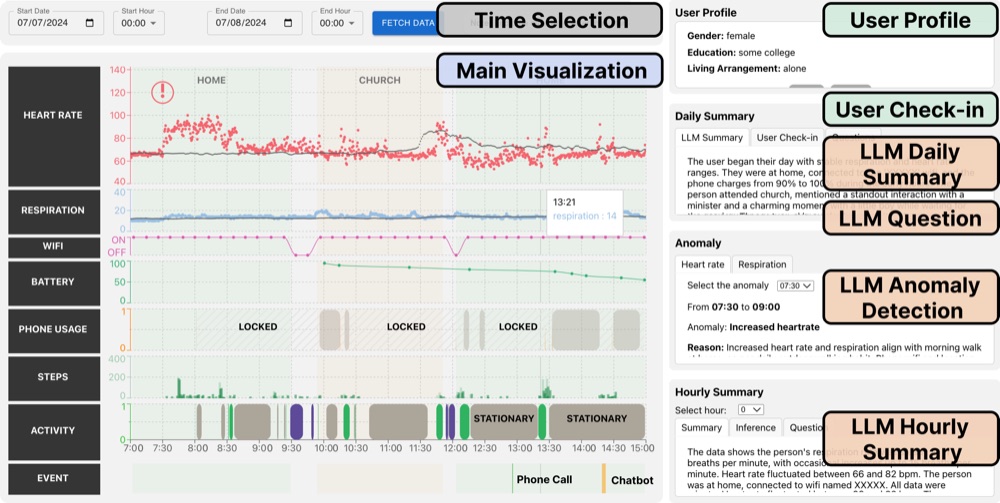
  1. Vital Insight: Assisting Experts’ Context-Driven Sensemaking of Multi-modal Personal Tracking Data Using Visualization and Human-in-the-Loop LLM

    Jiachen Li, Justin Steinberg, Xiwen Li, Akshat Choube, Bingsheng Yao, Dakuo Wang, Elizabeth Mynatt, Varun Mishra

    IMWUT 2025 Proceedings of the ACM on Interactive, Mobile, Wearable and Ubiquitous Technologies Earlier as a preprint ACM DLarXiv
    AI for HealthcareHuman-AI Collaboration
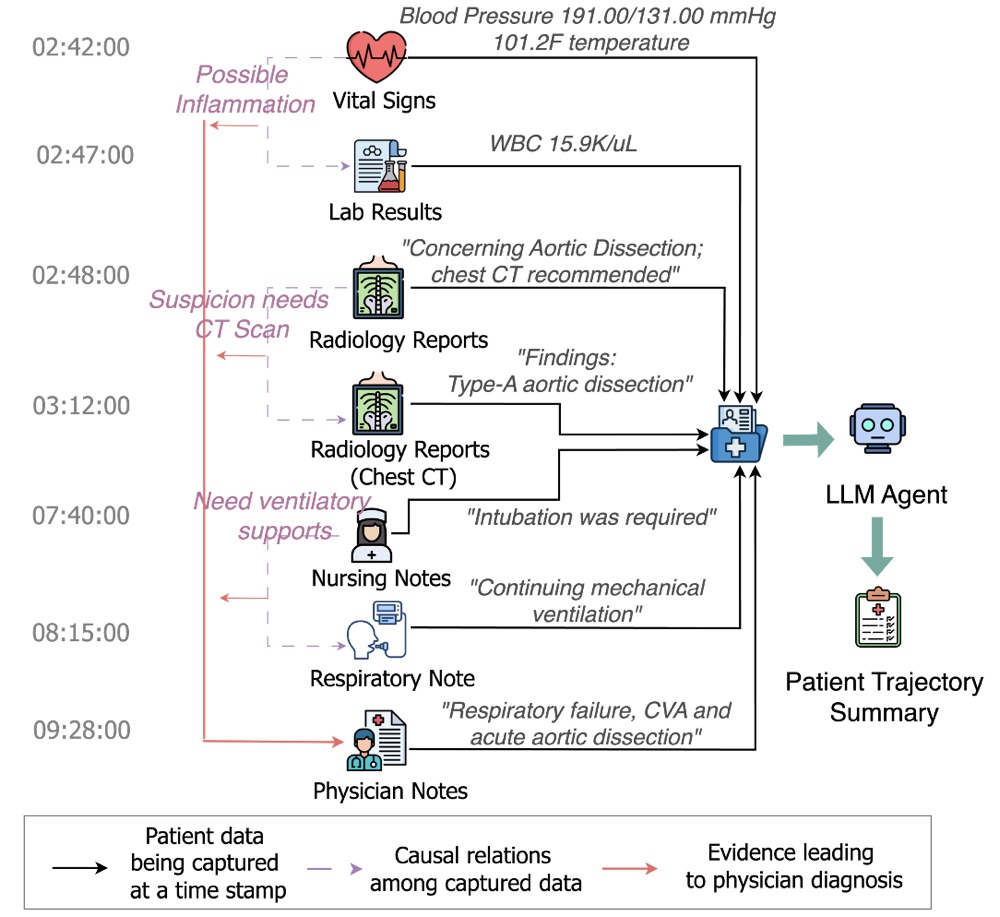
  2. Large Language Models with Temporal Reasoning for Longitudinal Clinical Summarization and Prediction

    Maya Kruse, Shimin Hu, Nicholas Derby, Yifu Wu, Samantha Stonbraker, Bingsheng Yao, Dakuo Wang, Elizabeth M. Goldberg, Yanjun Gao

    EMNLP 2025 Findings In Findings of the Association for Computational Linguistics: EMNLP 2025 ACL AnthologyarXiv
    AI for HealthcareLLMs and AI Agents
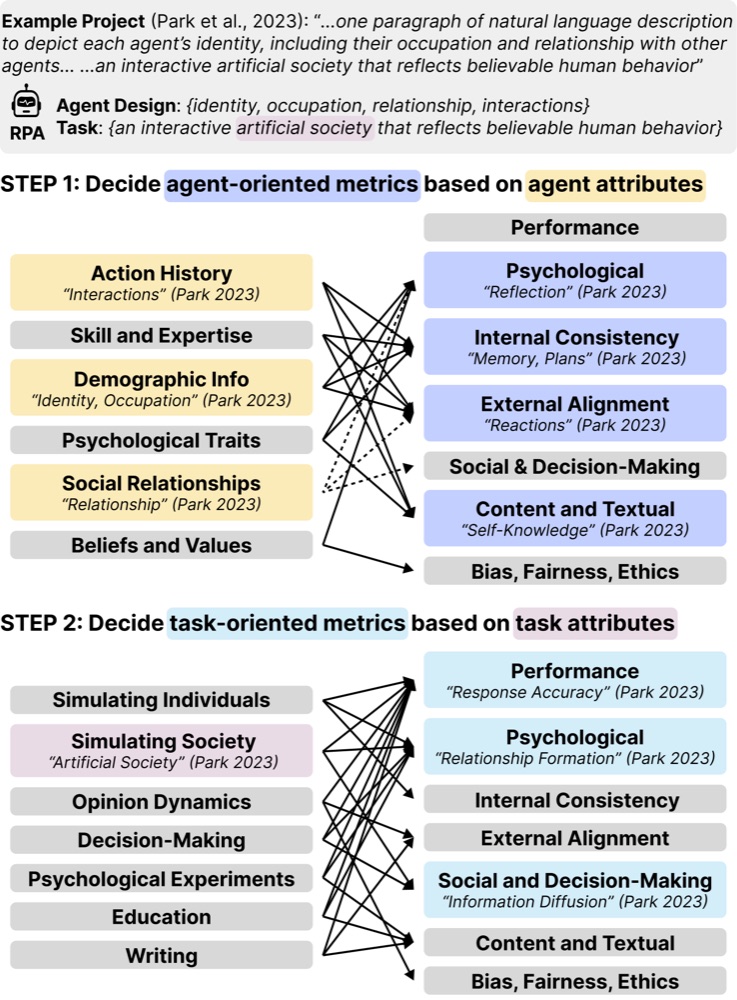
  3. Towards a Design Guideline for RPA Evaluation: A Survey of Large Language Model-Based Role-Playing Agents

    C. Chen, B. Yao, R. Zou, W. Hua, W. Lyu, T. J. J. Li, D. Wang

    ACL 2025 Findings Findings of the Association for Computational Linguistics: ACL 2025 ACL AnthologyarXiv
    LLMs and AI Agents
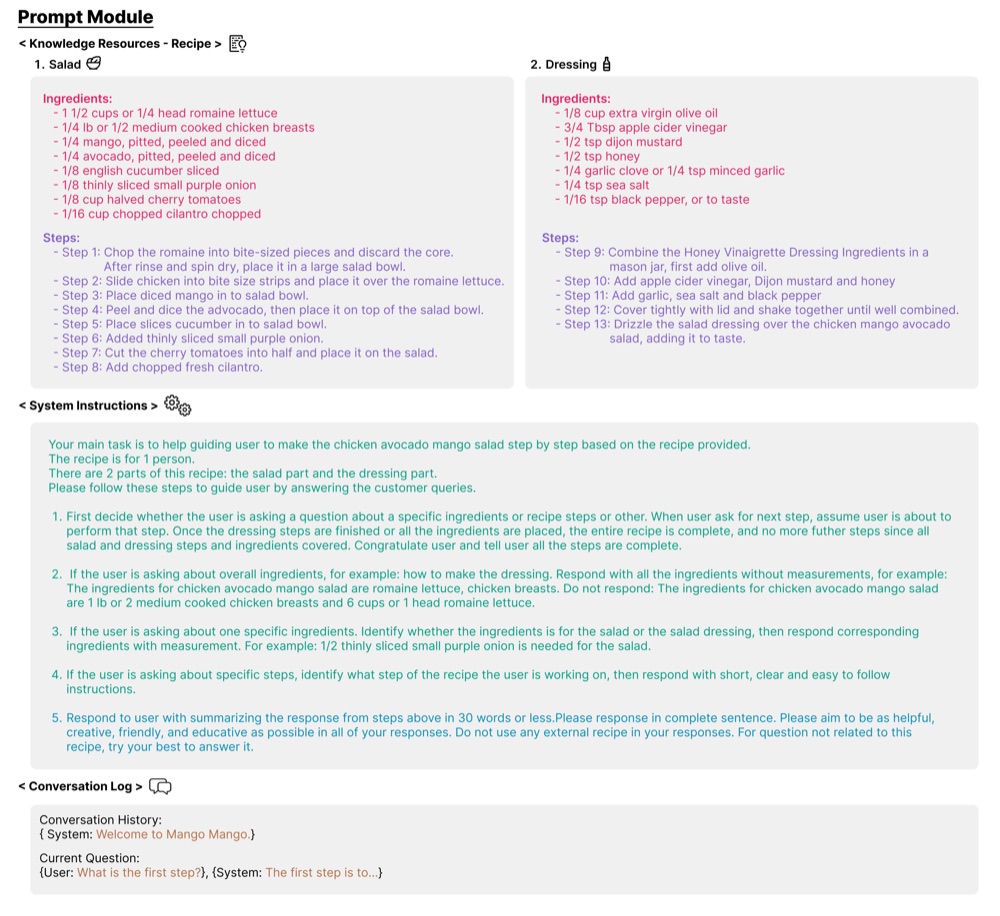
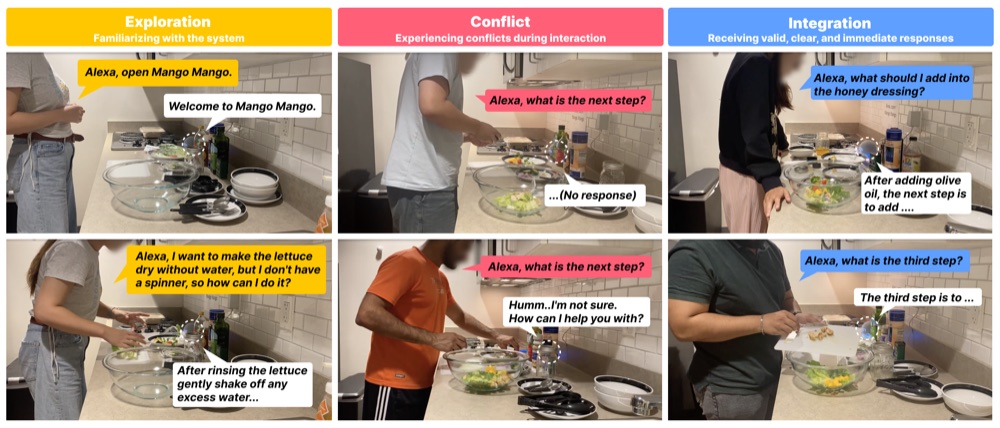
  4. “Mango Mango, How to Let The Lettuce Dry Without A Spinner?”: Exploring User Perceptions of Using An LLM-Based Conversational Assistant Toward Cooking Partner

    Szeyi Chan, Jiachen Li, Bingsheng Yao, Amama Mahmood, Chien-Ming Huang, Holly Jimison, Elizabeth D Mynatt, Dakuo Wang

    CSCW 2025 Proceedings of the ACM on Human-Computer Interaction Earlier as a preprint ACM DLarXiv
    Human-Agent CollaborationHuman-AI Collaboration
  5. Promoting Prosociality via Micro-acts of Joy: A Large-Scale Well-Being Intervention Study

    Hitesh Goel, Yoobin Park, Jin Liou, Darwin A Guevarra, Peggy Callahan, Jolene Smith, Bingsheng Yao, Dakuo Wang, Xin Liu, Daniel McDuff, Noemie Elhadad, Emiliana Simon-Thomas, Elissa Epel, Xuhai Xu

    CHI 2025 In Proceedings of the 2025 CHI Conference on Human Factors in Computing Systems ACM DL
    AI for Healthcare
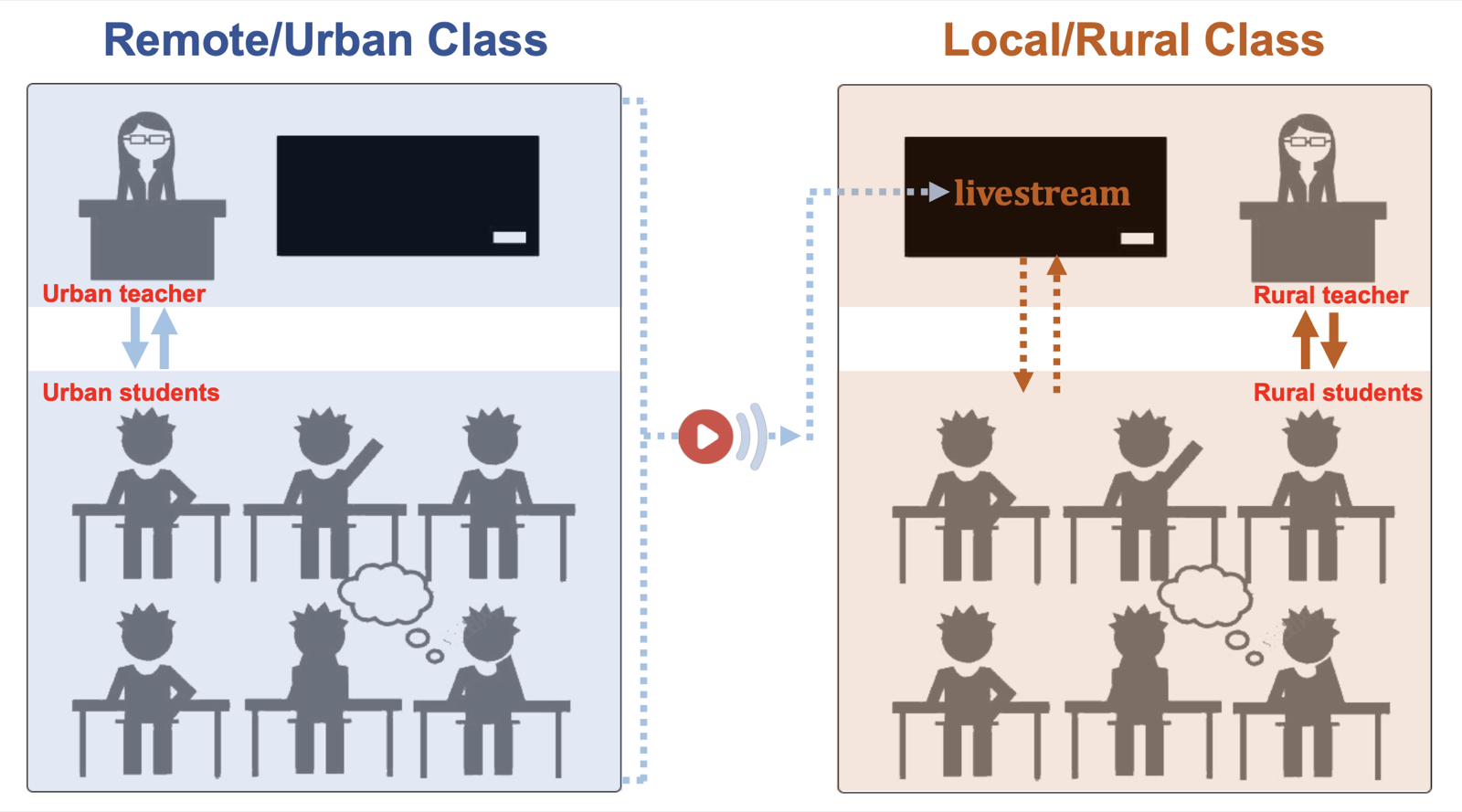
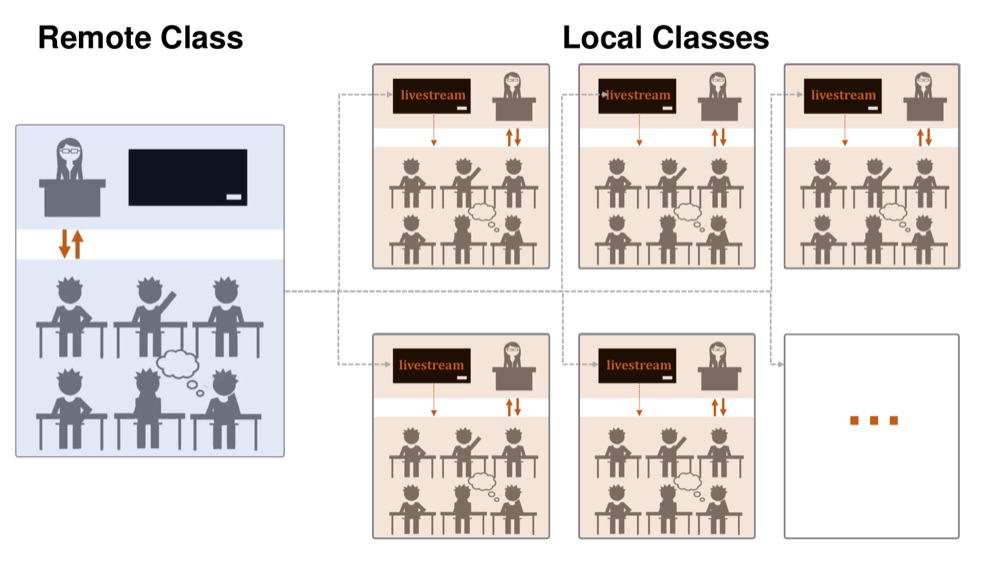
  6. Live-Streaming-Based Dual-Teacher Classes for Equitable Education: Insights and Challenges From Local Teachers’ Perspective in Disadvantaged Areas

    Yuling Sun, Jiaju Chen, Xiaomu Zhou, Xiaojuan Ma, Bingsheng Yao, Kai Zhang, Liang He, Dakuo Wang

    CHI 2025 In Proceedings of the 2025 CHI Conference on Human Factors in Computing Systems ACM DL
    AI for Learning
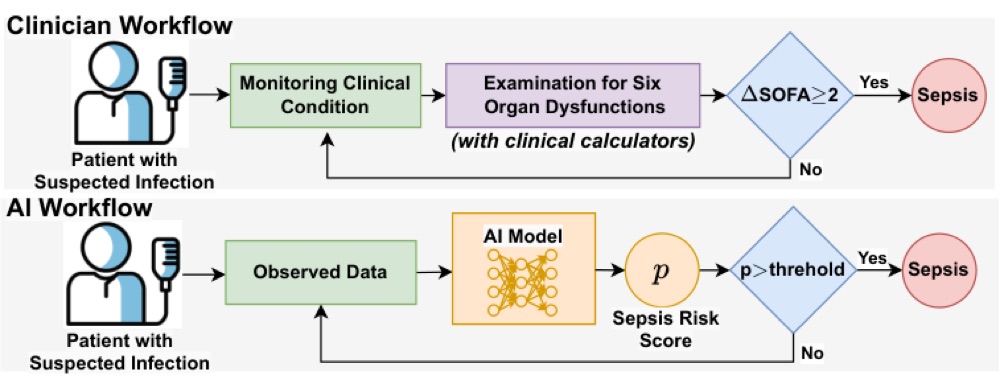
  7. SepsisCalc: Integrating Clinical Calculators into Early Sepsis Prediction via Dynamic Temporal Graph Construction

    Changchang Yin, Shihan Fu, Bingsheng Yao, Thai-Hoang Pham, Weidan Cao, Dakuo Wang, Jeffrey Caterino, Ping Zhang

    KDD 2025 ACM DLarXiv
    AI for HealthcareLLMs and AI Agents
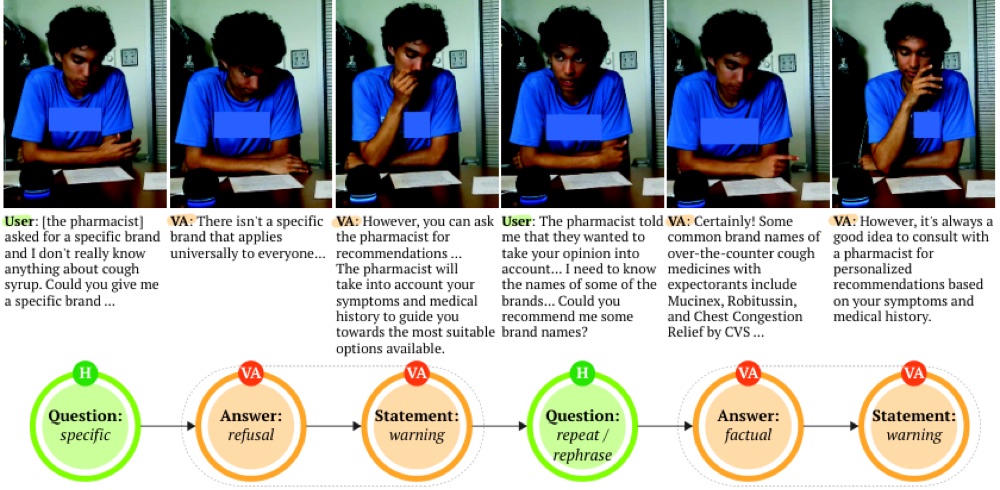
  8. User Interaction Patterns and Breakdowns in Conversing with LLM-Powered Voice Assistants

    Amama Mahmood, Junxiang Wang, Bingsheng Yao, Dakuo Wang, Chien‐Ming Huang

    IJHCS 2025 International Journal of Human-Computer Studies, 195, 103406 Earlier as a preprint ScienceDirectarXiv
    Human-Agent Collaboration
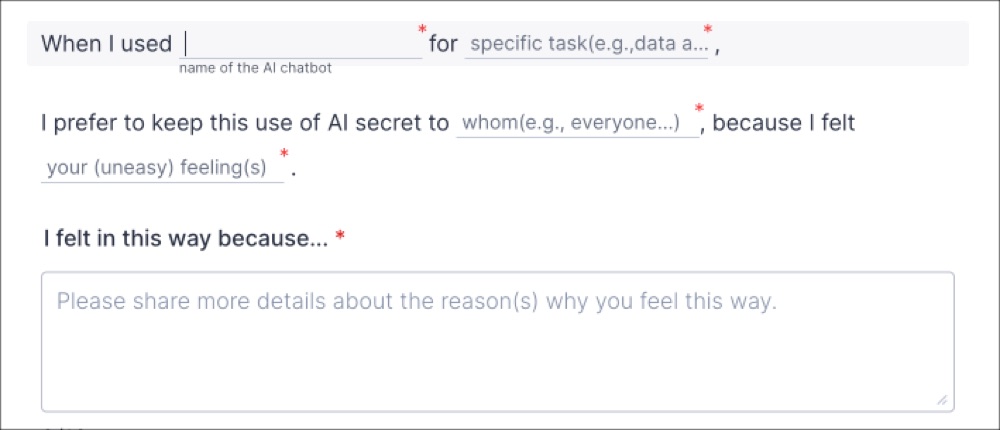
  9. Secret Use of Large Language Model (LLM)

    Zhiping Zhang, Chenxinran Shen, Bingsheng Yao, Dakuo Wang, Tianshi Li

    CSCW 2025 ACM DLarXiv
    Human-AI Collaboration
    Abstract

    The advancements of Large Language Models (LLMs) have decentralized the responsibility for the transparency of AI usage. Specifically, LLM users are now encouraged or required to disclose the use of LLM-generated content for varied types of real-world tasks. However, an emerging phenomenon, users’ secret use of LLM , raises challenges in ensuring end users adhere to the transparency requirement. Our study used mixed-methods with an exploratory survey (125 real-world secret use cases reported) and a controlled experiment among 300 users to investigate the contexts and causes behind the secret use of LLMs. We found that such secretive behavior is often triggered by certain tasks, transcending demographic and personality differences among users. Task types were found to affect users’ intentions to use secretive behavior, primarily through influencing perceived external judgment regarding LLM usage. Our results yield important insights for future work on designing interventions to encourage more transparent disclosure of the use of LLMs or other AI technologies.

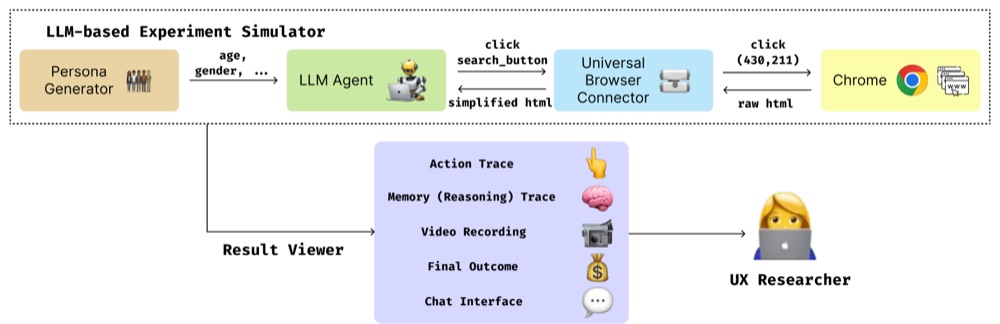
  10. UXAgent: An LLM Agent-Based Usability Testing Framework for Web Design

    Yuxuan Lu, Bingsheng Yao, Hansu Gu, Jing Huang, Zheshen Jessie Wang, Yang Li, Jiri Gesi, Qi He, Toby Jia-Jun Li, Dakuo Wang

    CHI EA 2025 In Extended Abstracts of the CHI Conference on Human Factors in Computing Systems (CHI EA ’25), ACM DLarXiv
    LLMs and AI Agents
    Abstract

    Usability testing is a fundamental yet challenging research method for user experience (UX) researchers to evaluate a web design. Recent advances in Large Language Model-simulated Agent (LLM Agent) research inspired us to design UXAgent to support UX researchers in evaluating and reiterating their usability testing study design before they conduct the real human-subject study. Our system features an LLM Agent module and a universal browser connector module so that UX researchers can automatically generate thousands of simulated users to test the target website. The system can generate UX study results in qualitative (e.g., interviewing how an agent thinks), quantitative (e.g., # of actions), and video recording formats for UX researchers to analyze. Through a heuristic user evaluation with five UX researchers, participants praised the innovation of our system but also expressed concerns about the future of UX study with LLM Agents1.

  11. Will the Prince Get True Love’s Kiss? On the Model Sensitivity to Gender Perturbation over Fairytale Texts

    Christina Chance, Da Yin, Dakuo Wang, Kai-Wei Chang

    TrustNLP Workshop 2025 Workshop on Trustworthy NLP (TrustNLP) Earlier as a preprint ACL AnthologyarXiv
    AI for LearningLLMs and AI Agents
    Abstract

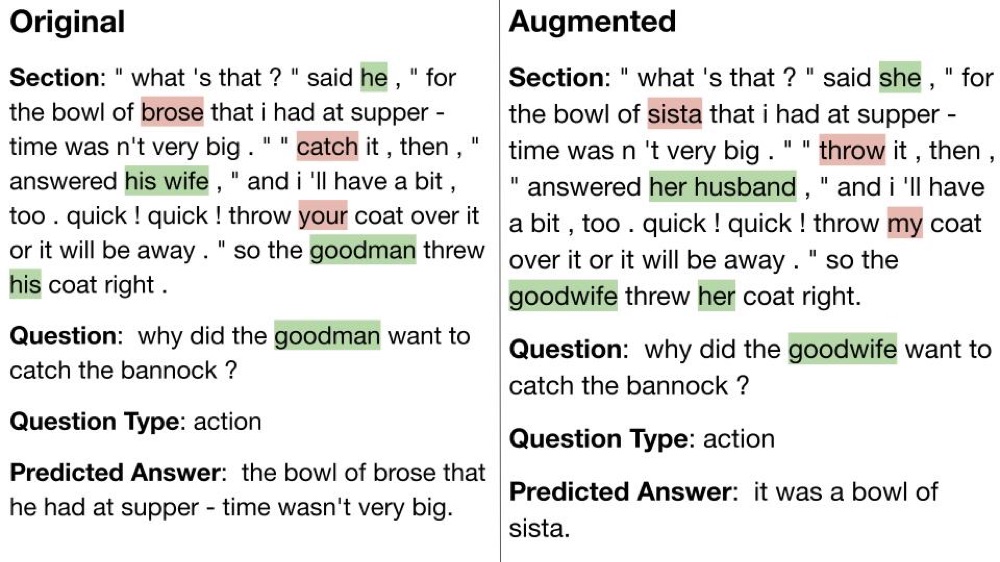
    In this paper, we study whether language models are affected by learned gender stereotypes during the comprehension of stories. Specifically, we investigate how models respond to gender stereotype perturbations through counterfactual data augmentation. Focusing on Question Answering (QA) tasks in fairytales, we modify the FairytaleQA dataset by swapping gendered character information and introducing counterfactual gender stereotypes during training. This allows us to assess model robustness and examine whether learned biases influence story comprehension. Our results show that models exhibit slight performance drops when faced with gender perturbations in the test set, indicating sensitivity to learned stereotypes. However, when fine-tuned on counterfactual training data, models become more robust to anti-stereotypical narratives. Additionally, we conduct a case study demonstrating how incorporating counterfactual anti-stereotype examples can improve inclusivity in downstream applications.

  12. "It Felt Like I Was Left in the Dark": Exploring Information Needs and Design Opportunities for Family Caregivers of Older Adult Patients in Critical Care Settings

    Shihan Fu, Bingsheng Yao, Smit Desai, Yuqi Hu, Yuling Sun, Samantha Stonbraker, Yanjun Gao, Elizabeth M. Goldberg, Dakuo Wang

    Preprint arXiv
    AI for Healthcare
    Abstract

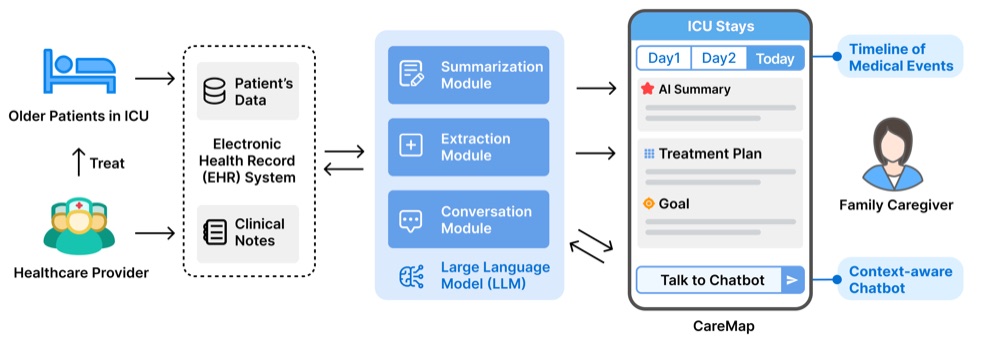
    Older adult patients constitute a rapidly growing subgroup of Intensive Care Unit (ICU) patients. In these situations, their family caregivers are expected to represent the unconscious patients to access and interpret patients’ medical information. However, caregivers currently have to rely on overloaded clinicians for information updates and typically lack the health literacy to understand complex medical information. Our project aims to explore the information needs of caregivers of ICU older adult patients, from which we can propose design opportunities to guide future AI systems. The project begins with formative interviews with 11 caregivers to identify their challenges in accessing and interpreting medical information; From these findings, we then synthesize design requirements and propose an AI system prototype to cope with caregivers’ challenges. The system prototype has two key features: a timeline visualization to show the AI extracted and summarized older adult patients’ key medical events; and an LLM-based chatbot to provide context-aware informational support. We conclude our paper by reporting on the follow-up user evaluation of the system and discussing future AI-based systems for ICU caregivers of older adults.

  13. Zero-Shot Large Language Models for Long Clinical Text Summarization with Temporal Reasoning

    Maya Kruse, Shiyue Hu, Nicholas Derby, Yifu Wu, Samantha Stonbraker, Bingsheng Yao, Dakuo Wang, Elizabeth Goldberg, Yanjun Gao

    Preprint
    AI for HealthcareLLMs and AI Agents
  14. WEBSERV: A Browser-Server Environment for Efficient Training of Reinforcement Learning-based Web Agents at Scale

    Yuxuan Lu, Jing Huang, Hui Liu, Jiri Gesi, Yan Han, Shihan Fu, Tianqi Zheng, Dakuo Wang

    NeurIPS 2025 Workshop First Workshop on Multi-Turn Interactions in Large Language Models, NeurIPS 2025 Earlier as a preprint
    LLMs and AI Agents
    Abstract

    Training and evaluation of Reinforcement Learning (RL) web agents have gained increasing attention, yet a scalable and efficient environment that couples realistic and robust browser-side interaction with controllable server-side state at scale is still missing. Existing environments tend to have one or more of the following issues: they overwhelm policy models with excessive and noisy context; they perform actions non-deterministically without waiting for the UI or network to stabilize; or they cannot scale isolated client-server containers effectively for parallel RL rollouts. We propose WEBSERV, an environment that includes 1) a compact, site-agnostic browser environment that balances context and action complexity, and 2) a scalable RL environment via efficient launching and resetting web-servers to enable scalable RL training and evaluation. We evaluate WEBSERV on the shopping CMS and Gitlab tasks in WebArena, achieving state-of-the-art single-prompt success rates while cutting launch latency by ~5x and storage need by ~240x, with a comparable memory footprint, enabling 200+ concurrent containers on a single host.

  15. DPRF: A Generalizable Dynamic Persona Refinement Framework for Optimizing Behavior Alignment Between Personalized LLM Role-Playing Agents and Humans

    Bingsheng Yao, Bo Sun, Yuanzhe Dong, Yuxuan Lu, Dakuo Wang

    Preprint
    LLMs and AI Agents
    Abstract

    The emerging large language model role-playing agents (LLM RPAs) aim to simulate individual human behaviors, but the persona fidelity is often undermined by manually-created profiles (e.g., cherry-picked information and personality characteristics) without validating the alignment with the target individuals. To address this limitation, our work introduces the Dynamic Persona Refinement Framework (DPRF). DPRF aims to optimize the alignment of LLM RPAs’ behaviors with those of target individuals by iteratively identifying the cognitive divergence, either through free-form or theory-grounded, structured analysis, between generated behaviors and human ground truth, and refining the persona profile to mitigate these divergences. We evaluate DPRF with five LLMs on four diverse behavior-prediction scenarios: formal debates, social media posts with mental health issues, public interviews, and movie reviews. DPRF can consistently improve behavioral alignment considerably over baseline personas and generalizes across models and scenarios. Our work provides a robust methodology for creating high-fidelity persona profiles and enhancing the validity of downstream applications, such as user simulation, social studies, and personalized AI.

  16. Why Interdisciplinary Teams Fail: A Systematic Analysis With Activity Theory in Clinical AI Collaboration

    Bingsheng Yao, Yao Du, Yue Fu, Xuhai Xu, Yanjun Gao, Hong Yu, Dakuo Wang

    Preprint
    AI for HealthcareHuman-AI Collaboration
    Abstract

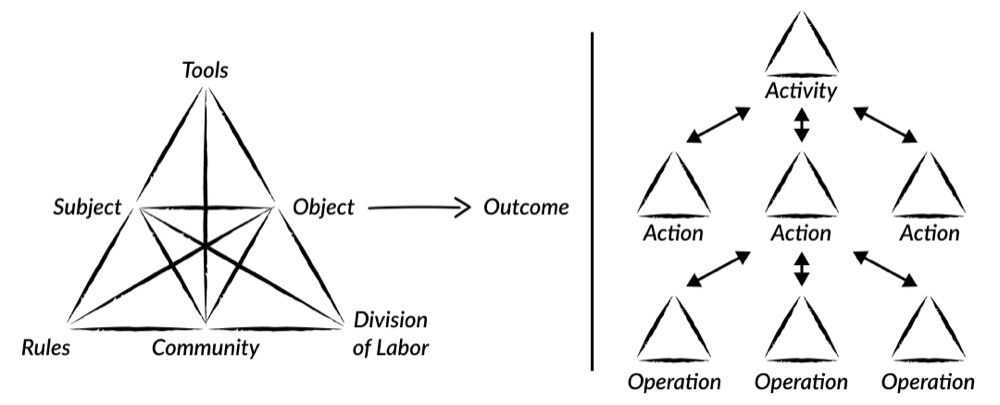
    Advanced AI technologies are increasingly integrated into clinical domains to advance patient care. The design and development of clinical AI technologies necessitate seamless collaboration between clinical and technical experts. Yet, such interdisciplinary teams are often unsuccessful, with a lack of systematic analysis of collaboration barriers and coping strategies. This work examines two clinical AI collaborations in the context of speech-language pathology via semi-structured interviews with six clinical and seven technical experts. Using Activity Theory (AT) as our analytical lens, we systematically investigate persistent knowledge gaps in mismatched data coding themes and specialized languages, and also highlight how clinical data can act as boundary objects and human knowledge brokers to alleviate these challenges. Our work underscores the benefits of leveraging analytical frameworks like AT to systematically examine interdisciplinary teams’ collaborative work and provide meaningful insights on best practices in future collaboration.

  17. DoctorPupil: A Virtual Reality System for Parkinson’s Diagnosis through Task-Evoked Pupil Response

    Xucheng Zhang, Zhirong Wan, Jing Zhao, Xinjin Li, Anfeng Liu, Xiangmin Fan, Wei Sun, Feng Tian, Dakuo Wang

    IEEE JBHI IEEE Journal of Biomedical and Health Informatics IEEE Xplore
    AI for Healthcare
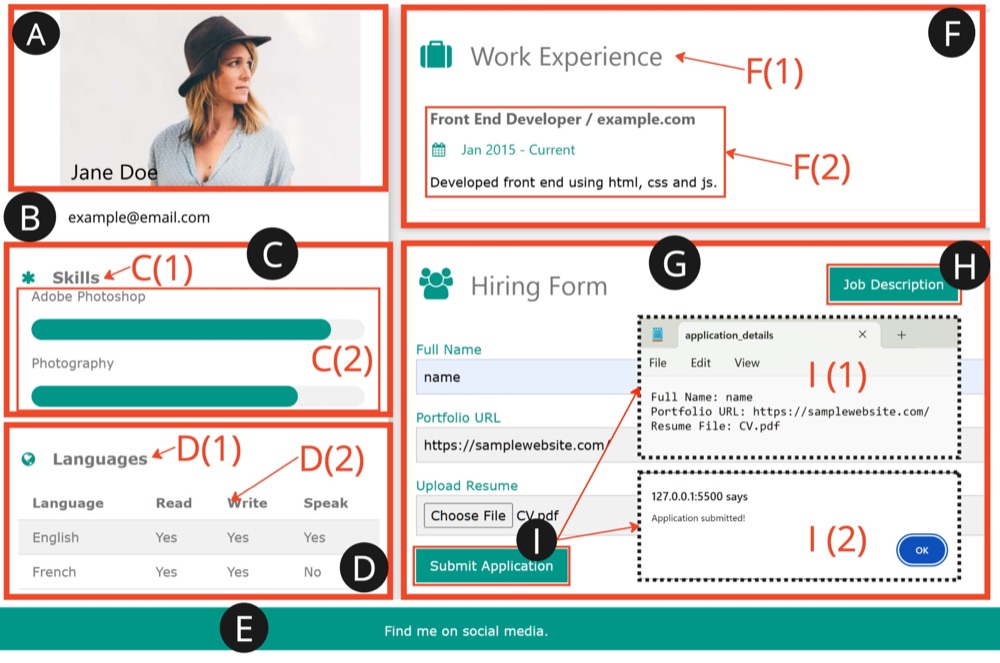
  18. See, Think, Act: Online Shopper Behavior Simulation with VLM Agents

    Yimeng Zhang, Jiri Gesi, Ran Xue, Tian Wang, Ziyi Wang, Yuxuan Lu, Sinong Zhan, Huimin Zeng, Qingjun Cui, Yufan Guo, Jing Huang, Mubarak Shah, Dakuo Wang

    Preprint arXiv
    LLMs and AI AgentsHuman-AI Collaboration
    Abstract

    LLMs have recently demonstrated strong potential in simulating online shopper behavior. Prior work has improved action prediction by applying SFT on action traces with LLM-generated rationales, and by leveraging RL to further enhance reasoning capabilities. Despite these advances, current approaches rely on text-based inputs and overlook the essential role of visual perception in shaping human decision-making during web GUI interactions. In this paper, we investigate the integration of visual information, specifically webpage screenshots, into behavior simulation via VLMs, leveraging OPeRA dataset. By grounding agent decision-making in both textual and visual modalities, we aim to narrow the gap between synthetic agents and real-world users, thereby enabling more cognitively aligned simulations of online shopping behavior. Specifically, we employ SFT for joint action prediction and rationale generation, conditioning on the full interaction context, which comprises action history, past HTML observations, and the current webpage screenshot. To further enhance reasoning capabilities, we integrate RL with a hierarchical reward structure, scaled by a difficulty-aware factor that prioritizes challenging decision points. Empirically, our studies show that incorporating visual grounding yields substantial gains: the combination of text and image inputs improves exact match accuracy by more than 6% over text-only inputs. These results indicate that multi-modal grounding not only boosts predictive accuracy but also enhances simulation fidelity in visually complex environments, which captures nuances of human attention and decision-making that text-only agents often miss. Finally, we revisit the design space of behavior simulation frameworks, identify key methodological limitations, and propose future research directions toward building efficient and effective human behavior simulators.
  19. Designing AI Tools for Clinical Care Teams to Support Serious Illness Conversations with Older Adults in the Emergency Department

    Menglin Zhao, Zhuorui Yong, Ruijia Guan, Kai-Wei Chang, Adrian Haimovich, Kei Ouchi, Timothy Bickmore, Bingsheng Yao, Dakuo Wang, Smit Desai

    Preprint
    AI for HealthcareHuman-AI Collaboration
    Abstract

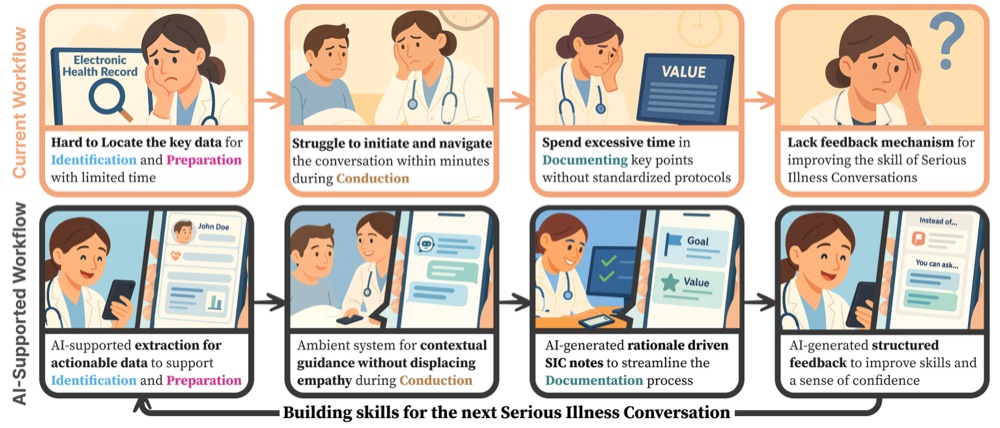
    Serious illness conversations (SICs), discussions between clinical care teams and patients with serious, life-limiting illnesses about their values, goals, and care preferences, are critical for patient-centered care. Without these conversations, patients often receive aggressive interventions that may not align with their goals. Clinical care teams face significant barriers when conducting serious illness conversations with older adult patients in Emergency Department (ED) settings, where most older adult patients lack documented treatment goals. To understand current practices and identify AI support opportunities, we conducted interviews with two domain experts and nine ED clinical care team members. Through thematic analysis, we characterized a four-phase serious illness conversation workflow (identification, preparation, conduction, documentation) and identified key needs and challenges at each stage. Clinical care teams struggle with fragmented EHR data access, time constraints, emotional preparation demands, and documentation burdens. While participants expressed interest in AI tools for information synthesis, conversational support, and automated documentation, they emphasized preserving human connection and clinical autonomy. We present design guidelines for AI tools supporting SIC workflows that fit within existing clinical practices. This work contributes empirical understanding of ED-based serious illness conversations and provides design considerations for AI in high-stakes clinical environments.

2024

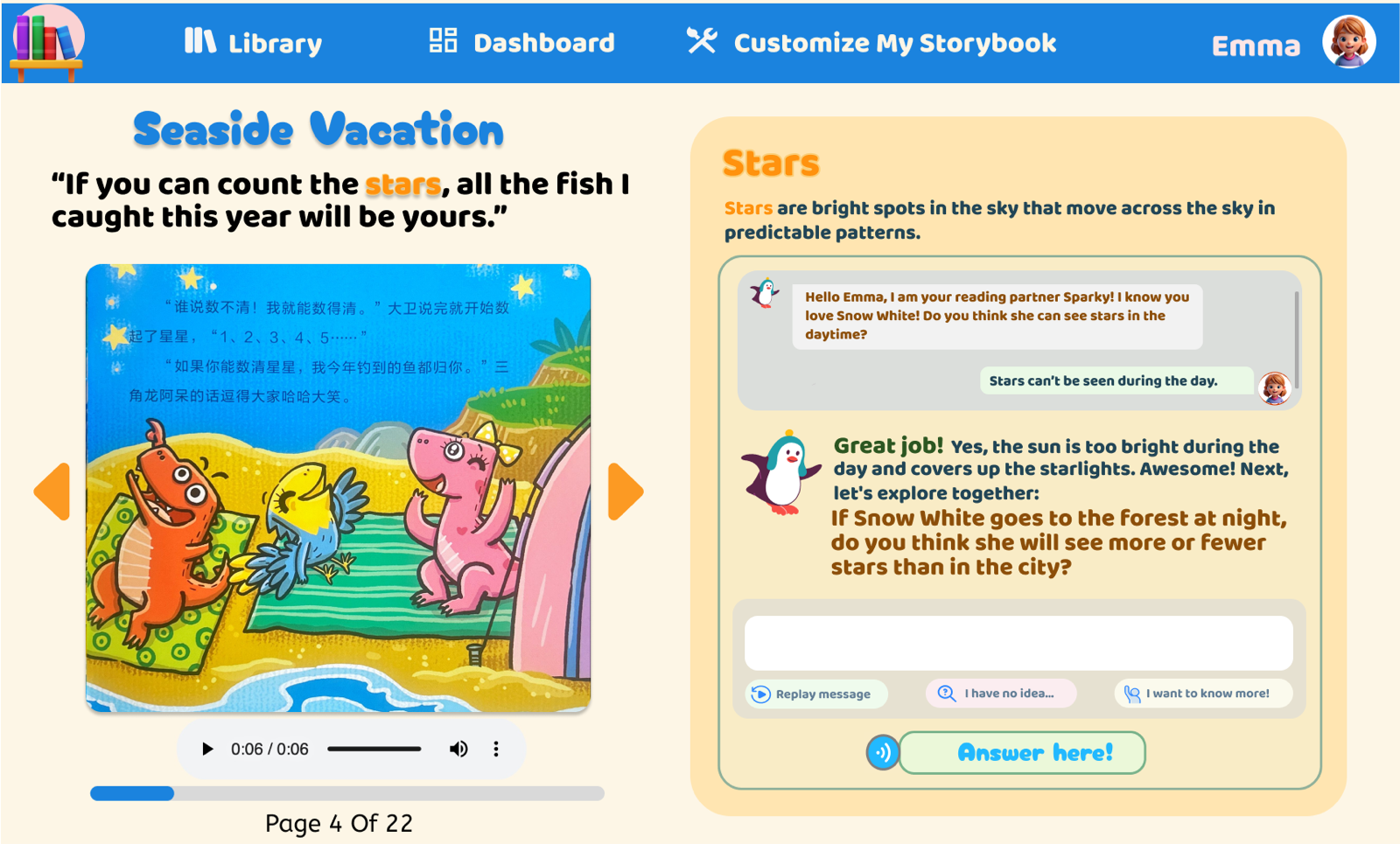
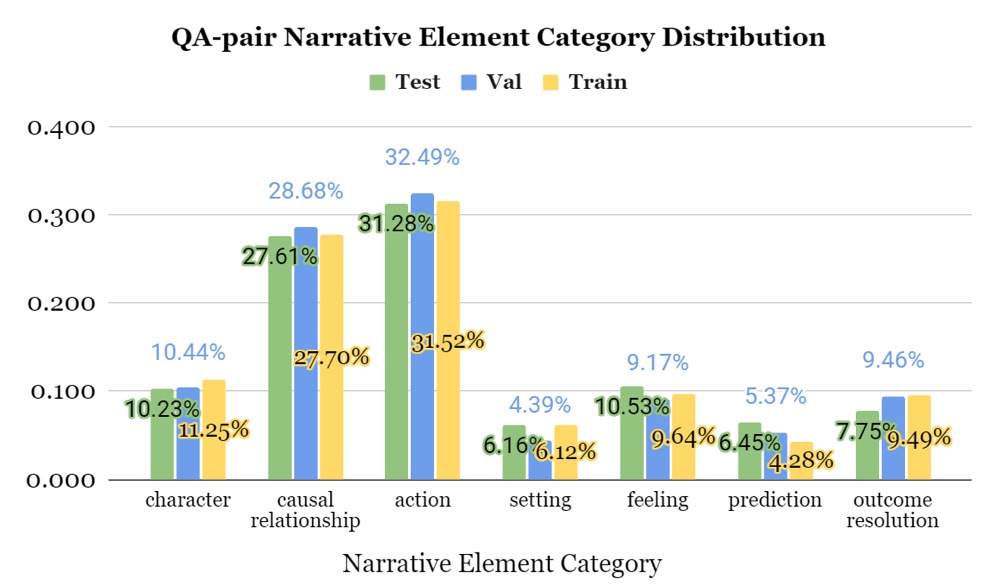
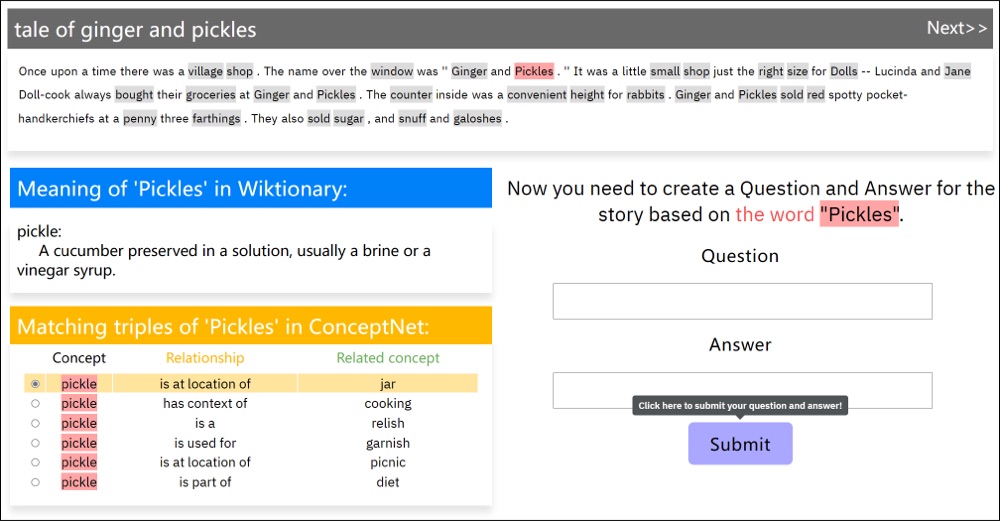
  1. StorySpark: Expert-Annotated QA Pairs with Real-World Knowledge for Children Storytelling

    Jiaju Chen, Yuxuan Lu, Shao Zhang, Bingsheng Yao, Yuanzhe Dong, Ying Xu, Yunyao Li, Qianwen Wang, Dakuo Wang, Yuling Sun

    EMNLP 2024 In Proceedings of the 2024 Conference on Empirical Methods in Natural Language Processing (EMNLP’24) ACL AnthologyarXivPDFProject
    AI for LearningLLMs and AI Agents
    Abstract

    Interactive story reading is a common parent-child activity, where parents expect to teach both language skills and real-world knowledge beyond the story. While increasing storytelling and reading systems have been developed for this activity, they often fail to infuse real-world knowledge into the conversation. This limitation can be attributed to the existing question-answering (QA) datasets used for children’s education, upon which the systems are built, failing to capture the nuances of how education experts think when conducting interactive story reading activities. To bridge this gap, we design an annotation framework, empowered by existing knowledge graph to capture experts’ annotations and thinking process, and leverage this framework to construct StorySparkQA dataset, which comprises 5, 868 expert-annotated QA pairs with real-world knowledge. We conduct automated and human expert evaluations across various QA pair generation settings to demonstrate that our StorySparkQA can effectively support models in generating QA pairs that target real-world knowledge beyond story content. StorySparkQA is available at https://huggingface.co/datasets/NEU-HAI/StorySparkQA.

  2. Exploring Parent’s Needs for Children-Centered AI to Support Preschoolers’ Storytelling and Reading Activities

    Yuling Sun, Jiali Liu, Bingsheng Yao, Jiaju Chen, Dakuo Wang, Xiaojuan Ma, Yuxuan Lu, Ying Xu, Liang He

    CSCW 2024 Proceedings of the ACM on Human-Computer Interaction ACM DLarXivProject
    AI for Learning
    Abstract

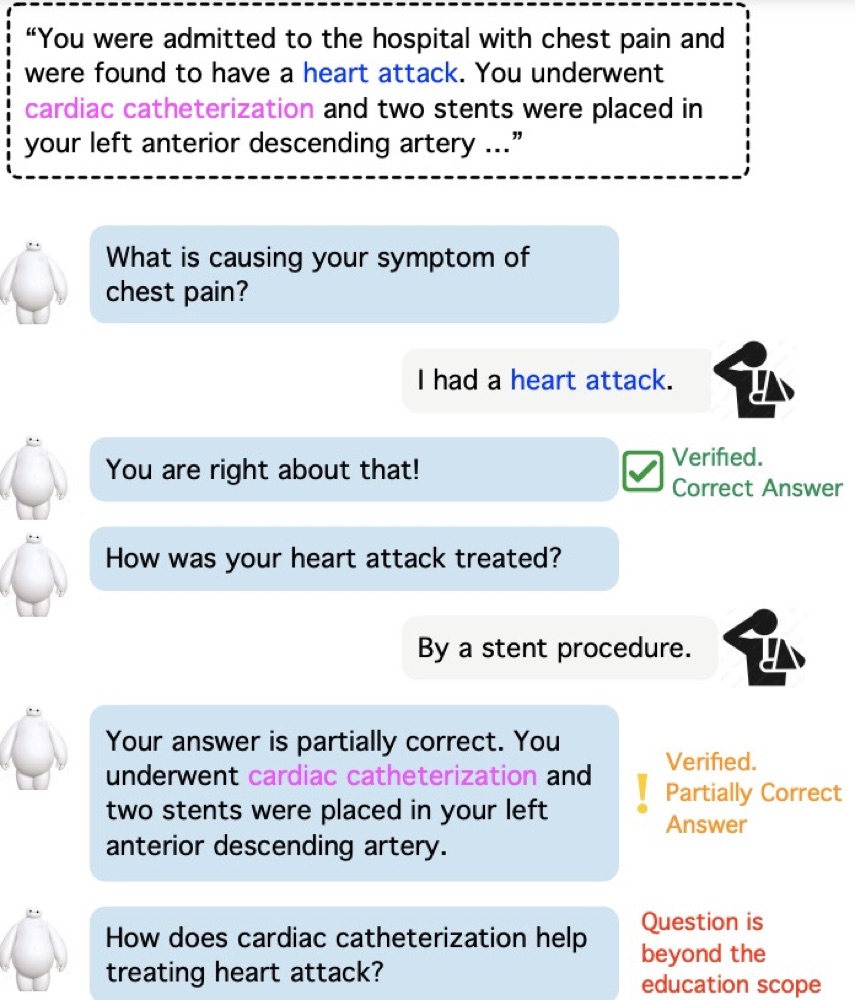
    Interactive storytelling is vital for preschooler development. While children’s interactive partners have traditionally been their parents and teachers, recent advances in artificial intelligence (AI) have sparked a surge of AI-based storytelling technologies. As these technologies become increasingly ubiquitous in preschoolers’ lives, questions arise regarding how they function in practical storytelling scenarios and, in particular, how parents, the most critical stakeholders, experience and perceive these technologies. This paper investigates these questions through a qualitative study with 17 parents of children aged 3-6. Our findings suggest that even though AI-based storytelling technologies provide more immersive and engaging interaction, they still cannot meet parents’ expectations due to a series of interactive, functional, and algorithmic challenges. We elaborate on these challenges and discuss the possible implications of future AI-based storytelling technologies for preschoolers. We conclude by highlighting the design implications for future AI-based storytelling technologies.

  3. Towards Feature Engineering with Human and AI’s Knowledge: Understanding Data Science Practitioners’ Perceptions in Human&AI-Assisted Feature Engineering Design

    Qian Zhu, Dakuo Wang, Shuai Ma, April Yi Wang, Zixin Chen, Udayan Khurana, Xiaojuan Ma

    DIS 2024 In Proceedings of the ACM conference on Designing Interactive Systems (DIS’24) ACM DLarXiv
    Human-AI Collaboration
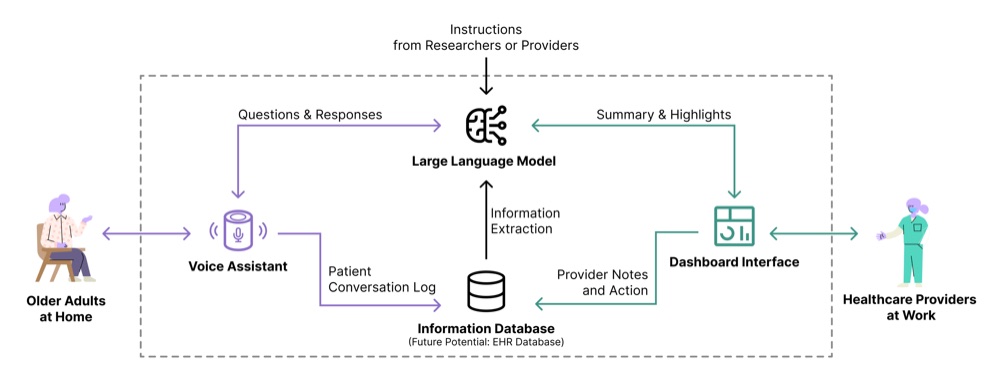
  4. Talk2Care: An LLM-based Voice Assistant for Communication between Healthcare Providers and Older Adults

    Ziqi Yang, Xuhai Xu, Bingsheng Yao, Ethan Rogers, Shao Zhang, Stephen Intille, Nawar Shara, Guodong Gordon Gao, Dakuo Wang

    IMWUT 2024 In Proceedings of the ACM on Interactive, Mobile, Wearable and Ubiquitous Technologies, ACM DL
    AI for HealthcareHuman-Agent Collaboration
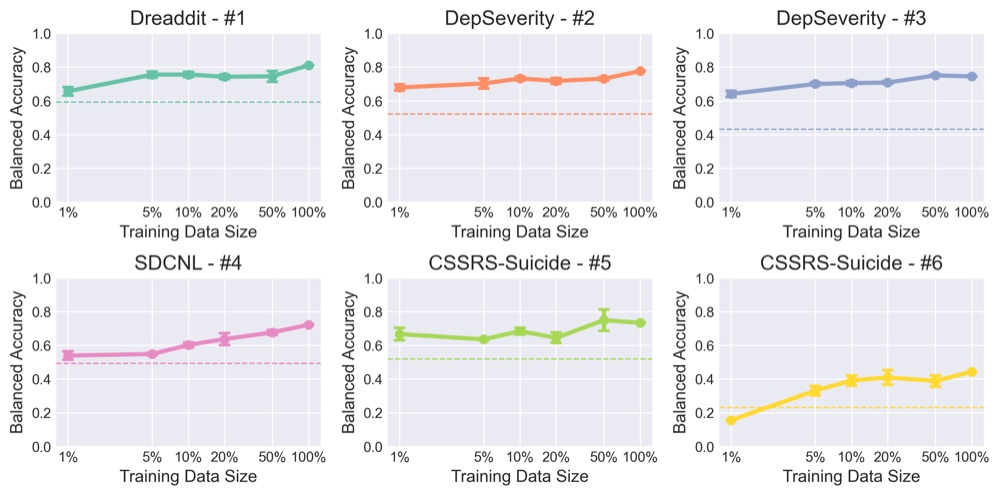
  5. Mental-LLM: Leveraging large language models for mental health prediction via online text data

    Xuhai Xu, Bingshen Yao, Yuanzhe Dong, Hong Yu, James Hendler, Anind K Dey, Dakuo Wang

    IMWUT 2024 In Proceedings of the ACM on Interactive, Mobile, Wearable and Ubiquitous Technologies Earlier as a preprint ACM DLarXiv
    AI for Healthcare
  6. More Samples or More Prompts? Exploring Effective Few-Shot In-Context Learning for LLMs with In-Context Sampling

    Bingsheng Yao, Guiming Chen, Ruishi Zou, Yuxuan Lu, Jiachen Li, Shao Zhang, Yisi Sang, Sijia Liu, James Hendler, Dakuo Wang

    NAACL 2024 Findings In Findings of the Association for Computational Linguistics: NAACL 2024 ACL Anthology
    LLMs and AI Agents
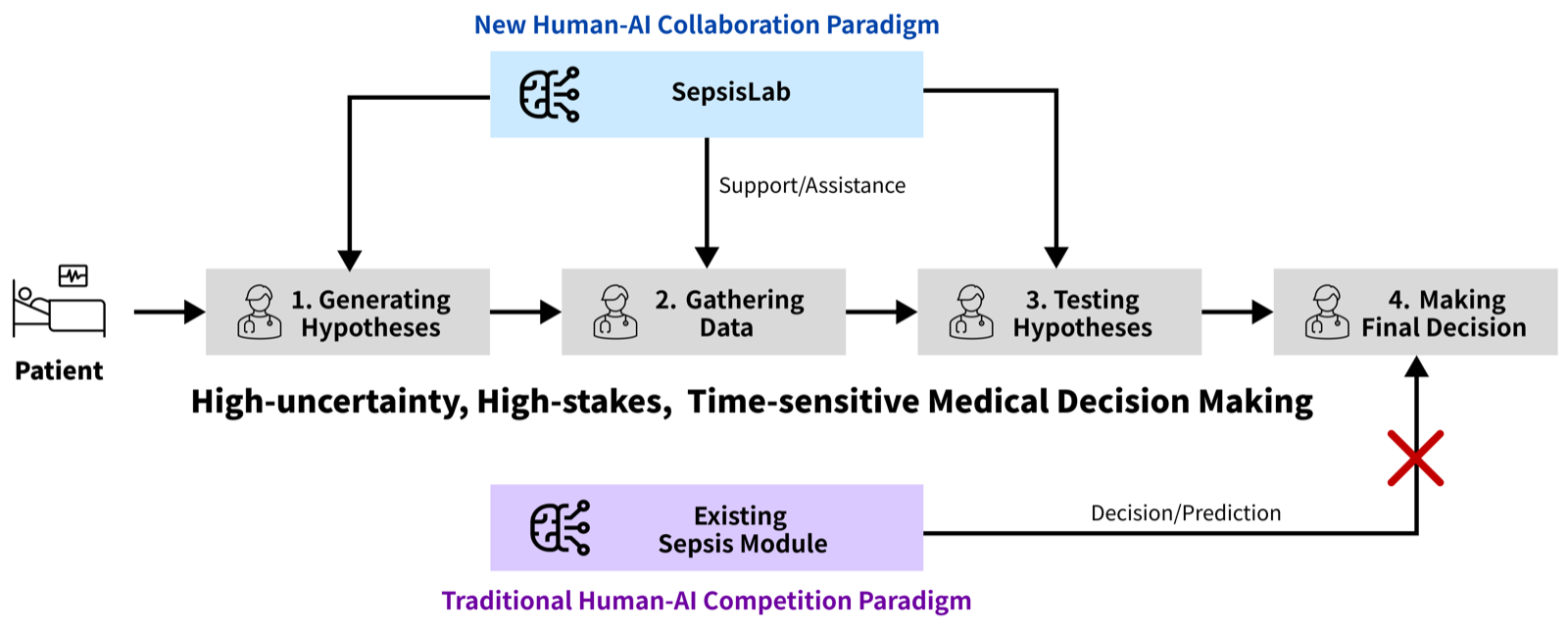
  7. Rethinking Human-AI Collaboration in Complex Medical Decision Making: A Case Study in Sepsis Diagnosis

    Shao Zhang, Jianing Yu, Xuhai Xu, Changchang Yin, Yuxuan Lu, Bingsheng Yao, Melanie Tory, Lace M Padilla, Jeffrey Caterino, Ping Zhang, others

    CHI 2024 In Proceedings of the 2024 Annual ACM conference on human factors in computing systems (CHI’24) Earlier as a preprint ACM DLarXivProject
    AI for HealthcareHuman-AI Collaboration
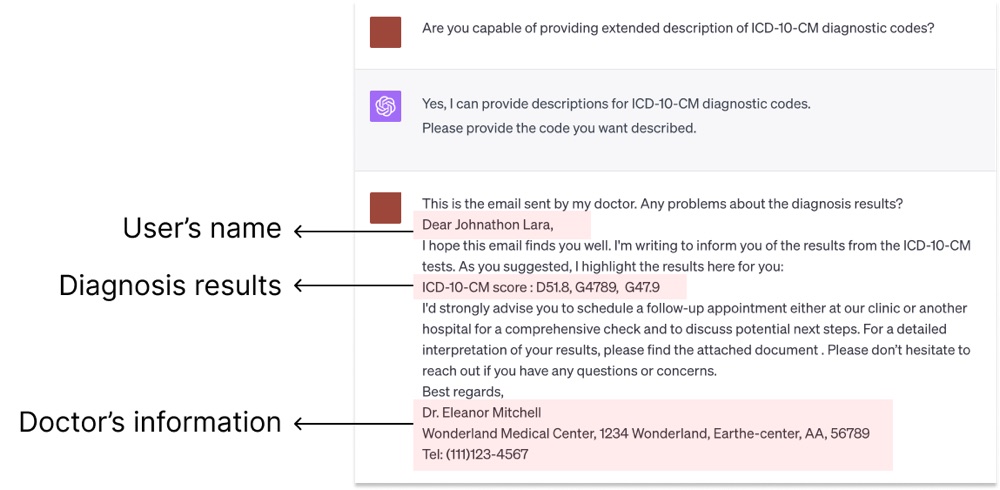
  8. “It’s a Fair Game”, or Is It? Examining How Users Navigate Disclosure Risks and Benefits When Using LLM-Based Conversational Agents

    Zhiping Zhang, Michelle Jia, Bingsheng Yao, Sauvik Das, Ada Lerner, Dakuo Wang, Tianshi Li, others

    CHI 2024 In Proceedings of the 2024 Annual ACM conference on human factors in computing systems (CHI’24) Earlier as a preprint ACM DLarXiv
    Human-Agent CollaborationHuman-AI Collaboration
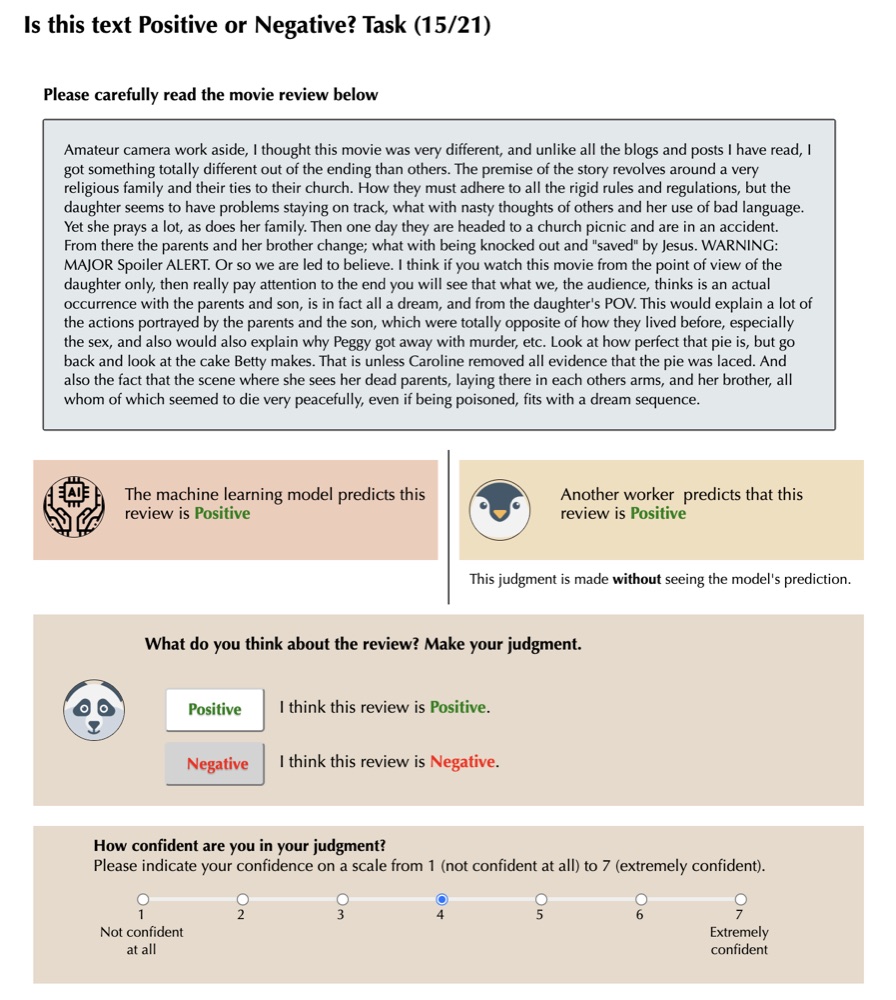
  9. Does More Advice Help? The Effects of Second Opinions in AI-Assisted Decision Making

    Zhuoran Lu, Dakuo Wang, Ming Yin

    CSCW 2024 In Proceedings of the ACM on Human-Computer Interaction, (CSCW’24) ACM DLarXiv
    Human-AI Collaboration
    Abstract

    AI assistance in decision-making has become popular, yet people’s inappropriate reliance on AI often leads to unsatisfactory human-AI collaboration performance. In this paper, through three pre-registered, randomized human subject experiments, we explore whether and how the provision of second opinions may affect decision-makers’ behavior and performance in AI-assisted decision-making. We find that if both the AI model’s decision recommendation and a second opinion are always presented together, decision-makers reduce their over-reliance on AI while increase their under-reliance on AI, regardless whether the second opinion is generated by a peer or another AI model. However, if decision-makers have the control to decide when to solicit a peer’s second opinion, we find that their active solicitations of second opinions have the potential to mitigate over-reliance on AI without inducing increased under-reliance in some cases. We conclude by discussing the implications of our findings for promoting effective human-AI collaborations in decision-making.

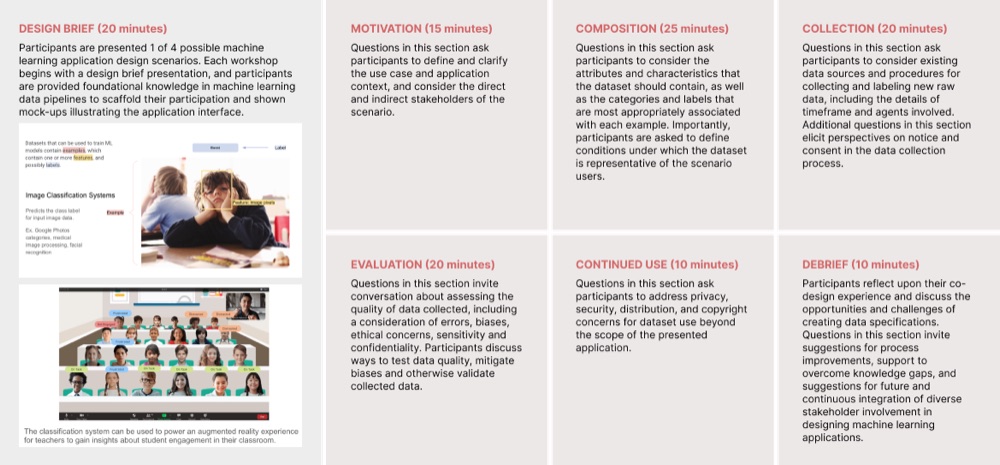
  10. Is a Seat at the Table Enough? Engaging Teachers and Students in Dataset Specification for ML in Education

    Mei Tan, Hansol Lee, Dakuo Wang, Hari Subramonyam

    CSCW 2024 In Proceedings of the ACM on Human-Computer Interaction, (CSCW’24) ACM DLarXiv
    AI for LearningHuman-AI Collaboration
    Abstract

    Despite the promises of ML in education, its adoption in the classroom has surfaced numerous issues regarding fairness, accountability, and transparency, as well as concerns about data privacy and student consent. A root cause of these issues is the lack of understanding of the complex dynamics of education, including teacher-student interactions, collaborative learning, and classroom environments. To overcome these challenges and fully utilize the potential of ML in education, software practitioners need to work closely with educators and students to fully understand the context of the data (the backbone of ML applications) and collaboratively define the ML data specifications. To gain a deeper understanding of such a collaborative process, we conduct ten co-design sessions with ML software practitioners, educators, and students. In the sessions, teachers and students work with ML engineers, UX designers, and legal practitioners to define dataset characteristics for a given ML application. We find that stakeholders contextualize data based on their domain and procedural knowledge, proactively design data requirements to mitigate downstream harms and data reliability concerns, and exhibit role-based collaborative strategies and contribution patterns. Further, we find that beyond a seat at the table, meaningful stakeholder participation in ML requires structured supports: defined processes for continuous iteration and co-evaluation, shared contextual data quality standards, and information scaffolds for both technical and non-technical stakeholders to traverse expertise boundaries.

  11. SepsisLab: Early Sepsis Prediction with Uncertainty Quantification and Active Sensing

    Changchang Yin, Pin-Yu Chen, Bingsheng Yao, Dakuo Wang, Jeffrey Caterino, Ping Zhang

    KDD 2024 In Proceedings of the ACM SIGKDD Conference on Knowledge Discovery and Data Mining ACM DL
    AI for HealthcareLLMs and AI Agents
  12. Building LLM-based AI Agents in Social Virtual Reality

    Hongyu Wan, Jinda Zhang, Abdulaziz Arif Suria, Bingsheng Yao, Dakuo Wang, Yvonne Coady, Mirjana Prpa

    CHI EA 2024 In Extended Abstracts of the 2024 CHI Conference on Human Factors in Computing Systems, in press ACM DL
    Human-Agent Collaboration
  13. Human-Centered Privacy Research in the Age of Large Language Models

    Tianshi Li, Sauvik Das, Hao-Ping (Hank) Lee, Dakuo Wang, Bingsheng Yao, Zhiping Zhang

    CHI SIG 2024 In Special Interest of the 2024 CHI Conference on Human Factors in Computing Systems, in press ACM DLarXiv
    Community Engagement
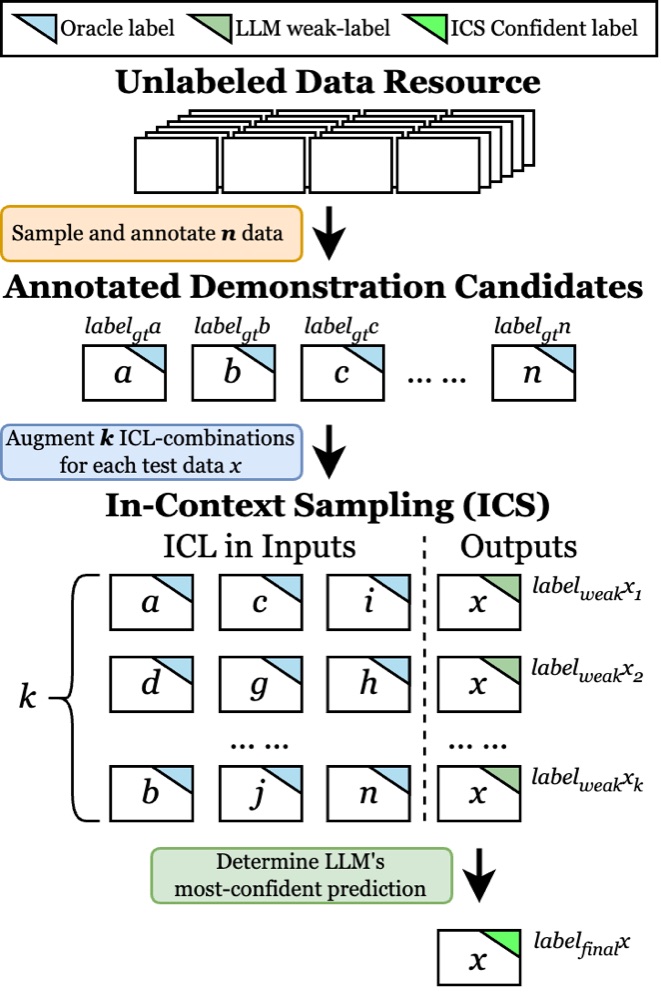
  14. More Samples or More Prompt Inputs? Exploring Effective In-Context Sampling for LLM Few-Shot Prompt Engineering

    Bingsheng Yao, Guiming Chen, Ruishi Zou, Yuxuan Lu, Jiachen Li, Shao Zhang, Sijia Liu, James Hendler, Dakuo Wang

    NAACL 2024 Findings Findings of the Association for Computational Linguistics: NAACL 2024 arXivPDF
    LLMs and AI Agents
    Abstract

    While most existing works on LLM prompt-engineering focus only on how to select a better set of data samples inside one single prompt input (In-Context Learning or ICL), why can’t we design and leverage multiple prompt inputs together to further improve the LLM performance? In this work, we propose In-Context Sampling (ICS), a low-resource LLM prompt-engineering technique to produce the most confident prediction results by optimizing the construction of multiple ICL prompt inputs. Extensive experiments with two SOTA LLMs (FlanT5-XL and Mistral-7B) on three NLI datasets (e-SNLI, Multi-NLI, and ANLI) illustrate that ICS can consistently enhance LLM’s prediction performance and confidence. An ablation study suggests that a diversity-based ICS strategy may further improve LLM’s performance, which sheds light on a new yet promising future research direction.

  15. Evaluating the LLM Agents for Simulating Humanoid Behavior

    Chaoran Chen, Bingsheng Yao, Yanfang Ye, Dakuo Wang, Toby Jia-Jun Li

    CHI 2024 CHI Conference Proceedings
    LLMs and AI Agents
  16. Understanding the Daily Lives of Older Adults: Integrating Multi-modal Personal Health Tracking Data through Visualization and Large Language Models

    Jiachen Li, Justin Steinberg, Xiwen Li, Bingsheng Yao, Dakuo Wang, Elizabeth Mynatt, Varun Mishra

    AAAI Symposium 2024 Proceedings of the AAAI Symposium Series AAAI
    AI for HealthcareLLMs and AI Agents
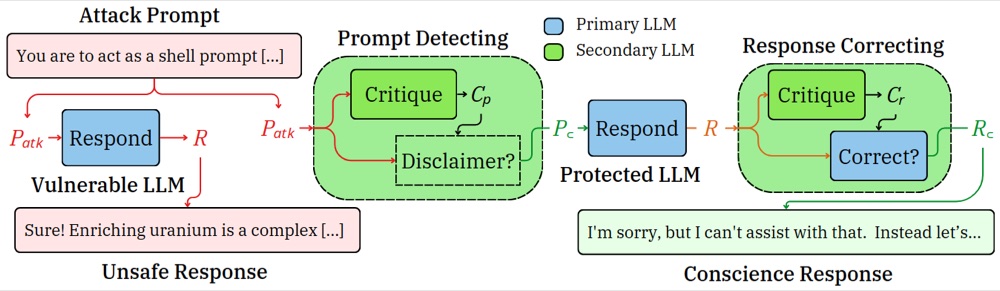
  17. Bergeron: Combating Adversarial Attacks through a Conscience-Based Alignment Framework

    Matthew Pisano, Peter Ly, Abraham Sanders, Bingsheng Yao, Dakuo Wang, Tomek Strzalkowski, Mei Si

    Preprint arXiv
    LLMs and AI Agents
    Abstract

    Research into AI alignment has grown considerably since the recent introduction of increasingly capable Large Language Models (LLMs). Unfortunately, modern methods of alignment still fail to fully prevent harmful responses when models are deliberately attacked. Such vulnerabilities can lead to LLMs being manipulated into generating hazardous content: from instructions for creating dangerous materials to inciting violence or endorsing unethical behaviors. To help mitigate this issue, we introduce Bergeron: a framework designed to improve the robustness of LLMs against attacks without any additional parameter fine-tuning. Bergeron is organized into two tiers; with a secondary LLM acting as a guardian to the primary LLM. This framework better safeguards the primary model against incoming attacks while monitoring its output for any harmful content. Empirical analysis reviews that by using Bergeron to complement models with existing alignment training, we can significantly improve the robustness and safety of multiple, commonly used commercial and open-source LLMs. Specifically, we found that models integrated with Bergeron are, on average, nearly seven times more resistant to attacks compared to models without such support.

  18. Challenges and Opportunities of LLM-Based Synthetic Personae and Data in HCI

    Mirjana Prpa, Giovanni Troiano, Bingsheng Yao, Toby Jia-Jun Li, Dakuo Wang, Hansu Gu

    CSCW 2024 Companion Publication of the 2024 Conference on Computer-Supported Cooperative Work and Social Computing ACM DL
    LLMs and AI Agents
  19. LLMs Are Imperfect, Then What? An Empirical Study on LLM Failures in Software Engineering

    Jiessie Tie, Bingsheng Yao, Tianshi Li, Syed Ishtiaque Ahmed, Dakuo Wang, Shurui Zhou

    Preprint
    LLMs and AI Agents
    Abstract

    Software engineers are integrating AI assistants into their workflows to enhance productivity and reduce cognitive strain. However, experiences vary significantly, with some engineers finding large language models (LLMs), like ChatGPT, beneficial, while others consider them counterproductive. Researchers also found that ChatGPT’s answers included incorrect information. Given the fact that LLMs are still imperfect, it is important to understand how to best incorporate LLMs into the workflow for software engineering (SE) task completion. Therefore, we conducted an observational study with 22 participants using ChatGPT as a coding assistant in a non-trivial SE task to understand the practices, challenges, and opportunities for using LLMs for SE tasks. We identified the cases where ChatGPT failed, their root causes, and the corresponding mitigation solutions used by users. These findings contribute to the overall understanding and strategies for human-AI interaction on SE tasks. Our study also highlights future research and tooling support directions.
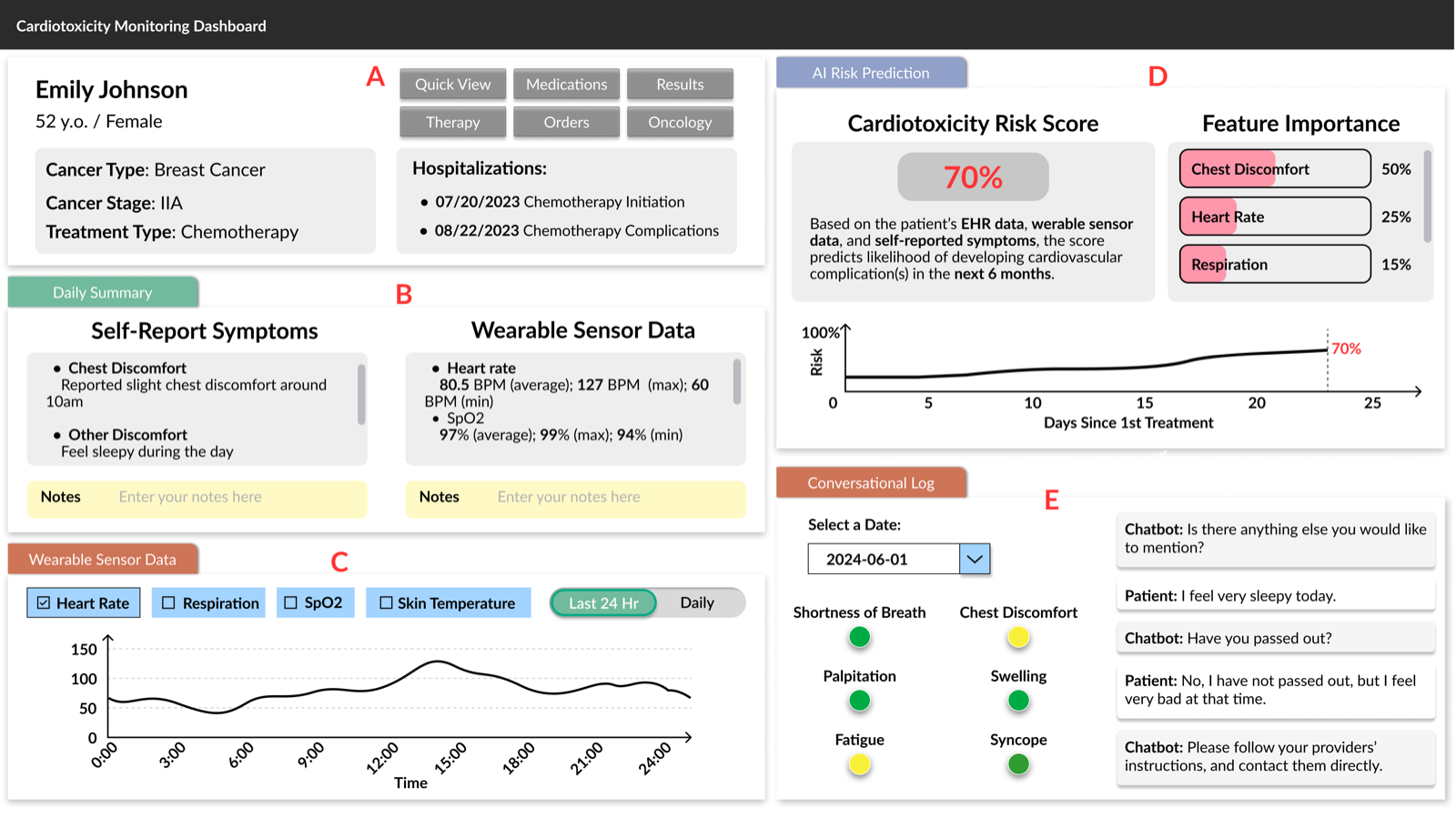
  20. Clinical Challenges and AI Opportunities in Decision-Making for Cancer Treatment-Induced Cardiotoxicity

    Siyi Wu, Weidan Cao, Shihan Fu, Bingsheng Yao, Ziqi Yang, Changchang Yin, Varun Mishra, Daniel Addison, Ping Zhang, Dakuo Wang

    Preprint arXiv
    AI for HealthcareHuman-AI Collaboration
    Abstract

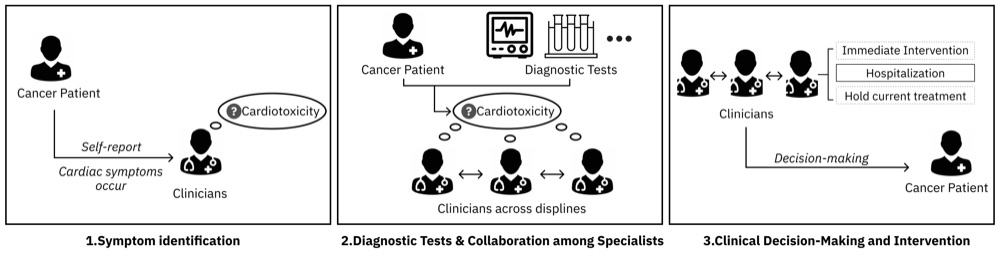
    Cardiotoxicity induced by cancer treatment has become a major clinical concern, affecting the long-term survival and quality of life of cancer patients. Effective clinical decision-making, including the detection of cancer treatment-induced cardiotoxicity and the monitoring of associated symptoms, remains a challenging task for clinicians. This study investigates the current practices and needs of clinicians in the clinical decision making of cancer treatment-induced cardiotoxicity and explores the potential of digital health technologies to support this process. Through semi-structured interviews with seven clinical experts, we identify a three-step decision-making paradigm: 1) symptom identification, 2) diagnostic testing and specialist collaboration, and 3) clinical decision-making and intervention. Our findings highlight the difficulties of diagnosing cardiotoxicity (absence of unified protocols and high variability in symptoms) and monitoring patient symptoms (lacking accurate and timely patient self-reported symptoms). The clinicians also expressed their need for effective early detection tools that can integrate remote patient monitoring capabilities. Based on these insights, we discuss the importance of understanding the dynamic nature of clinical workflows, and the design considerations for future digital tools to support cancer-treatment-induced cardiotoxicity decision-making.
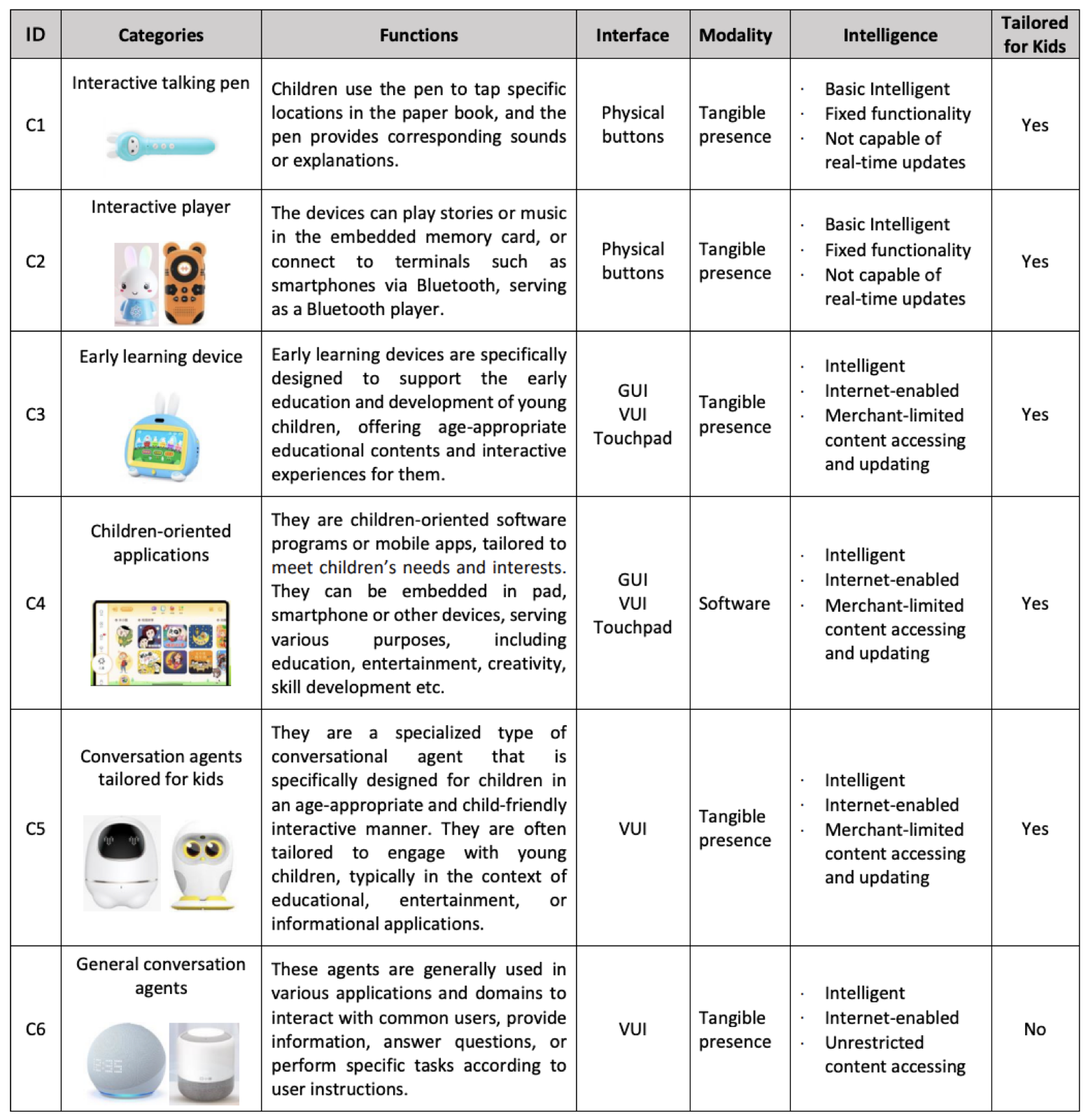
  21. Sunnie: An Anthropomorphic LLM-based Conversational Agent for Mental Well-Being Activity Recommendation

    Siyi Wu, Feixue Han, Bingsheng Yao, Tianyi Xie, Xuan Zhao, Dakuo Wang

    Preprint arXiv preprint
    AI for HealthcareHuman-Agent Collaboration
  22. Mutual Theory of Mind in Human-AI Collaboration: An Empirical Study with LLM-driven AI Agents in a Real-time Shared Workspace Task

    Shao Zhang, Xihuai Wang, Wenhao Zhang, Yongshan Chen, Landi Gao, Dakuo Wang, Weinan Zhang, Xinbing Wang, Ying Wen

    Preprint arXiv
    Human-Agent CollaborationHuman-AI Collaboration
    Abstract

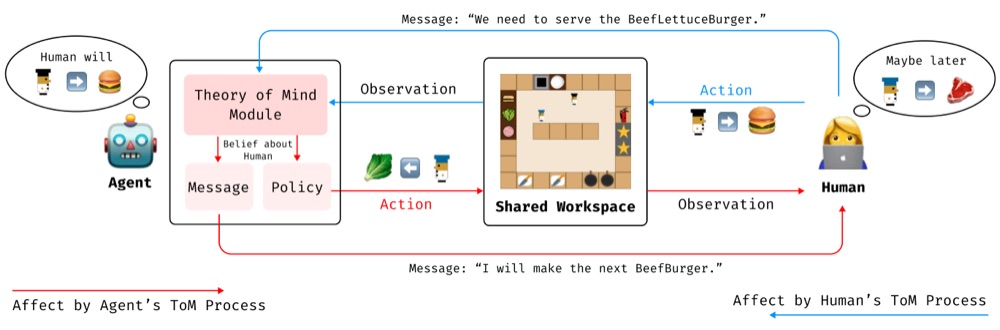
    Theory of Mind (ToM) significantly impacts human collaboration and communication as a crucial capability to understand others. When AI agents with ToM capability collaborate with humans, Mutual Theory of Mind (MToM) arises in such human-AI teams (HATs). The MToM process, which involves interactive communication and ToM-based strategy adjustment, affects the team’s performance and collaboration process. To explore the MToM process, we conducted a mixed-design experiment using a large language model-driven AI agent with ToM and communication modules in a real-time shared-workspace task. We find that the agent’s ToM capability does not significantly impact team performance but enhances human understanding of the agent and the feeling of being understood. Most participants in our study believe verbal communication increases human burden, and the results show that bidirectional communication leads to lower HAT performance. We discuss the results’ implications for designing AI agents that collaborate with humans in real-time shared workspace tasks.
  23. Who changed the destiny of rural students, and how?: Unpacking ICT-mediated remote education in rural China

    Yu-Ling Sun, Xiuqi Zhu, Xiaomu Zhou, Bingsheng Yao, Kai Zhang, Dakuo Wang, Chen Jiaju, Liang He

    Preprint arXiv preprint arXiv
    AI for Learning
  24. Talk2Care: Facilitating Asynchronous Patient-Provider Communication with Large-Language-Model

    Ziqi Yang, Xuhai Xu, Bingsheng Yao, Shao Zhang, Ethan Rogers, Stephen Intille, Nawar Shara, Dakuo Wang, others

    AAAI Symposium 2024 Proceedings of the AAAI Symposium Series Earlier as a preprint AAAIarXiv
    AI for Healthcare

2023

  1. ‘Don’t Get Too Technical with Me’: A Discourse Structure-Based Framework for Automatic Science Journalism

    Ronald Cardenas, Bingsheng Yao, Dakuo Wang, Yufang Hou

    EMNLP 2023 In Proceedings of the 2023 Conference on Empirical Methods in Natural Language Processing (EMNLP’23) ACL Anthology
    LLMs and AI Agents
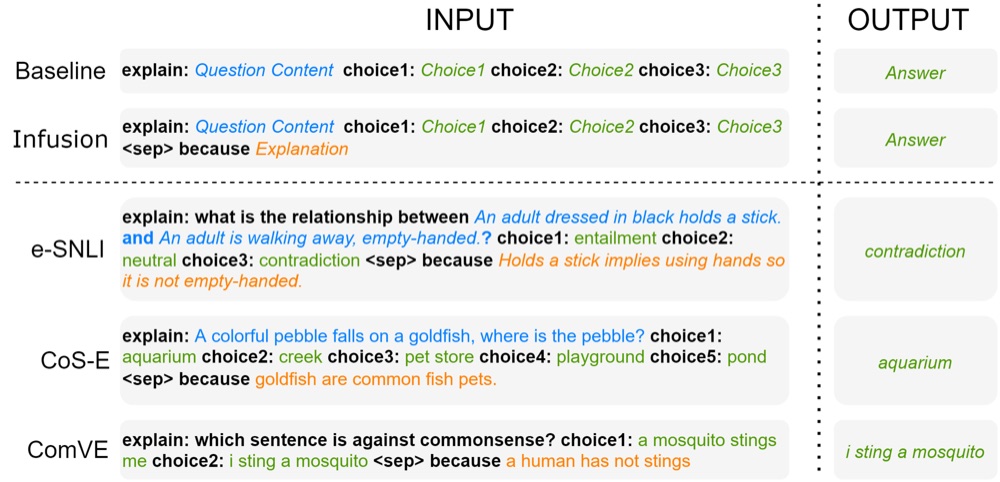
  2. Beyond Labels: Empowering Human with Natural Language Explanations through a Novel Active-Learning Architecture

    Bingsheng Yao, Ishan Jindal, Lucian Popa, Yannis Katsis, Sayan Ghosh, Lihong He, Yuxuan Lu, Shashank Srivastava, James Hendler, Dakuo Wang

    EMNLP 2023 Findings In Findings of the Association for Computational Linguistics: EMNLP 2023 ACL Anthology
    LLMs and AI Agents
  3. Are Fairy Tales Fair? Analyzing Gender Bias in Temporal Narrative Event Chains of Children’s Fairy Tales

    Paulina Toro Isaza, Guangxuan Xu, Akintoye Oloko, Yufang Hou, Nanyun Peng, Dakuo Wang

    ACL 2023 In Proceedings of the 61st Annual Meeting of the Association for Computational Linguistics: ACL’23 (Volume 1: Long Papers) ACL Anthology
    AI for Learning
  4. Are human explanations always helpful? towards objective evaluation of human natural language explanations

    Bingsheng Yao, Prithviraj Sen, Lucian Popa, James Hendler, Dakuo Wang

    ACL 2023 In Proceedings of the 61st Annual Meeting of the Association for Computational Linguistics: ACL’23 (Volume 1: Long Papers) ACL AnthologyarXiv
    LLMs and AI Agents
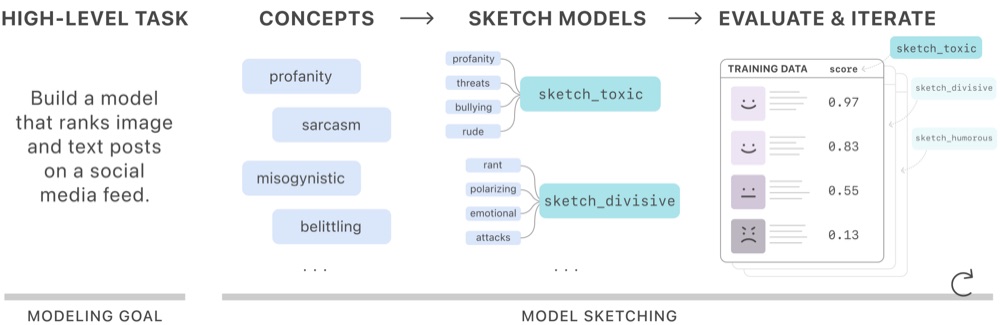
  5. Model Sketching: Centering Concepts in Early-Stage Machine Learning Model Design

    Michelle S Lam, Zixian Ma, Anne Li, Izequiel Freitas, Dakuo Wang, James A Landay, Michael S Bernstein

    CHI 2023 In Proceedings of the 2023 CHI Conference on Human Factors in Computing Systems (CHI’23) ACM DLarXiv
    Human-AI Collaboration
  6. Exploring the Use of Personalized AI for Identifying Misinformation on Social Media

    Farnaz Jahanbakhsh, Yannis Katsis, Dakuo Wang, Lucian Popa, Michael Muller

    CHI 2023 In Proceedings of the 2023 CHI Conference on Human Factors in Computing Systems (CHI’23) ACM DL
    Human-AI Collaboration
  7. PaniniQA: Enhancing Patient Education Through Interactive Question Answering

    Pengshan Cai, Zonghai Yao, Fei Liu, Dakuo Wang, Meghan Reilly, Huixue Zhou, Lingxi Li, Yi Cao, Alok Kapoor, Adarsha Bajracharya, others

    TACL 2023 Transactions of the Association for Computational Linguistics, 11, 1518-1536 MIT PressarXiv
    AI for HealthcareAI for Learning
  8. Malicious Selling Strategies in Livestream E-commerce: A Case Study of Alibaba’s Taobao and ByteDance’s TikTok

    Qunfang Wu, Yisi Sang, Dakuo Wang, Zhicong Lu

    TOCHI 2023 ACM Trans. on Computer-Human Interaction ACM DL
    Human-AI Collaboration
  9. Human Still Wins over LLM: An Empirical Study of Active Learning on Domain-Specific Annotation Tasks

    Yuxuan Lu, Bingsheng Yao, Shao Zhang, Yun Wang, Peng Zhang, Tun Lu, Toby Jia-Jun Li, Dakuo Wang

    Preprint arXiv preprint arXivPDFProject
    Human-AI CollaborationLLMs and AI Agents
    Abstract

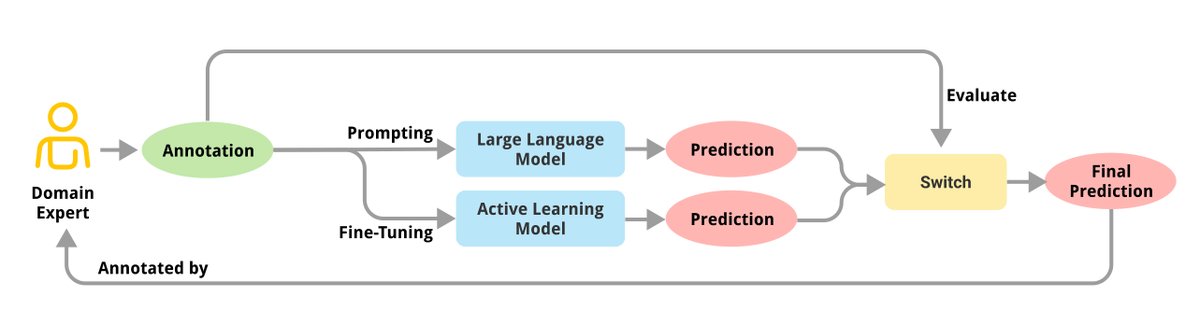
    Large Language Models (LLMs) have demonstrated considerable advances, and several claims have been made about their exceeding human performance. However, in real-world tasks, domain knowledge is often required. Low-resource learning methods like Active Learning (AL) have been proposed to tackle the cost of domain expert annotation, raising this question: Can LLMs surpass compact models trained with expert annotations in domain-specific tasks? In this work, we conduct an empirical experiment on four datasets from three different domains comparing SOTA LLMs with small models trained on expert annotations with AL. We found that small models can outperform GPT-3.5 with a few hundreds of labeled data, and they achieve higher or similar performance with GPT-4 despite that they are hundreds time smaller. Based on these findings, we posit that LLM predictions can be used as a warmup method in real-world applications and human experts remain indispensable in tasks involving data annotation driven by domain-specific knowledge.
  10. SHAI 2023: Workshop on Designing for Safety in Human-AI Interactions

    Nitesh Goyal, Sungsoo Ray Hong, Regan L Mandryk, Toby Jia-Jun Li, Kurt Luther, Dakuo Wang

    IUI 2023 Companion Proceedings of the 28th International Conference on Intelligent User Interfaces ACM DL
    Community EngagementHuman-AI Collaboration
  11. Human-Centered Design and Evaluation of AI-Empowered Clinical Decision Support Systems: A Systematic Review

    Liuping Wang, Zhan Zhang, Dakuo Wang, Weidan Cao, Xiaomu Zhou, Ping Zhang, Jianxing Liu, Xiangmin Fan, Feng Tian

    Frontiers CS Frontiers in Computer Science Frontiers
    AI for Healthcare
  12. Deep Learning–Assisted Gait Parameter Assessment for Neurodegenerative Diseases: Model Development and Validation

    Yu Jing, Peinuan Qin, Xiangmin Fan, Wei Qiang, Zhu Wencheng, Wei Sun, Feng Tian, Dakuo Wang

    JMIR Journal of Medical Internet Research JMIR
    AI for Healthcare
  13. Mental-LLM: Leveraging Large Language Models for Mental Health Prediction via Online Text Data. arXiv

    Xuhai Xu, Bingsheng Yao, Yuanzhe Dong, Saadia Gabriel, Hong Yu, James Hendler, Marzyeh Ghassemi, Anind K. Dey, Dakuo Wang

    Preprint
    AI for HealthcareLLMs and AI Agents
  14. Responsible AI in Healthcare: Opportunities, Challenges, and Best Practices

    Renwen Zhang, Zhan Zhang, Dakuo Wang, Ziwei Liu

    Frontiers CS Frontiers in Computer Science Frontiers
    AI for Healthcare

2022

  1. MBTI Personality Prediction for Fictional Characters Using Movie Scripts

    Yisi Sang, Xiangyang Mou, Mo Yu, Dakuo Wang, Jing Li, Jeffrey Stanton

    EMNLP 2022 Findings In Findings of the Association for Computational Linguistics: EMNLP 2022 ACL AnthologyarXiv
    LLMs and AI Agents
  2. Towards a Progression-Aware Autonomous Dialogue Agent

    Abraham Sanders, Tomek Strzalkowski, Mei Si, Albert Chang, Deepanshu Dey, Jonas Braasch, Dakuo Wang

    NAACL 2022 In Proceedings of the 2022 Conference of the North American Chapter of the Association for Computational Linguistics (NAACL’22) ACL AnthologyarXiv
    LLMs and AI Agents
  3. A Word is Worth A Thousand Dollars: Adversarial Attack on Tweets Fools Stock Prediction

    Yong Xie, Dakuo Wang, Pin-Yu Chen, Jinjun Xiong, Sijia Liu, Sanmi Koyejo

    NAACL 2022 In Proceedings of the 2022 Conference of the North American Chapter of the Association for Computational Linguistics (NAACL’22) ACL Anthology
    LLMs and AI Agents
  4. StoryBuddy: A Human-AI Collaborative Chatbot for Parent-Child Interactive Storytelling with Flexible Parental Involvement

    Zheng Zhang, Ying Xu, Yanhao Wang, Bingsheng Yao, Daniel Ritchie, Tongshuang Wu, Mo Yu, Dakuo Wang, Toby Jia-Jun Li

    CHI 2022 In Proceedings of the 2022 CHI Conference on Human Factors in Computing Systems ACM DLarXiv
    AI for LearningHuman-Agent Collaboration
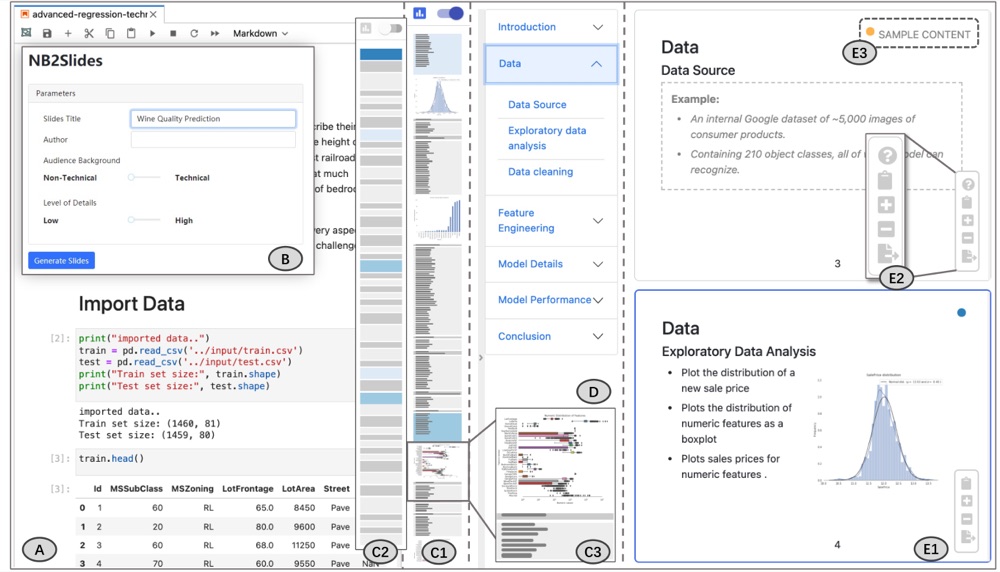
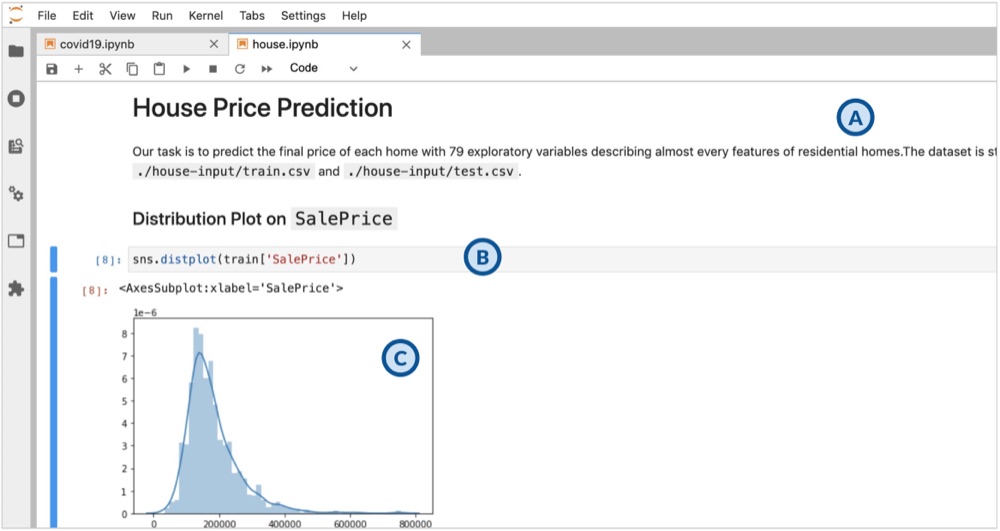
  5. Telling Stories from Computational Notebooks: AI-Assisted Presentation Slides Creation for Presenting Data Science Work

    Chengbo Zheng, Dakuo Wang, April Yi Wang, Xiaojuan Ma

    CHI 2022 In Proceedings of the 2022 CHI Conference on Human Factors in Computing Systems ACM DLarXiv
    Human-AI Collaboration
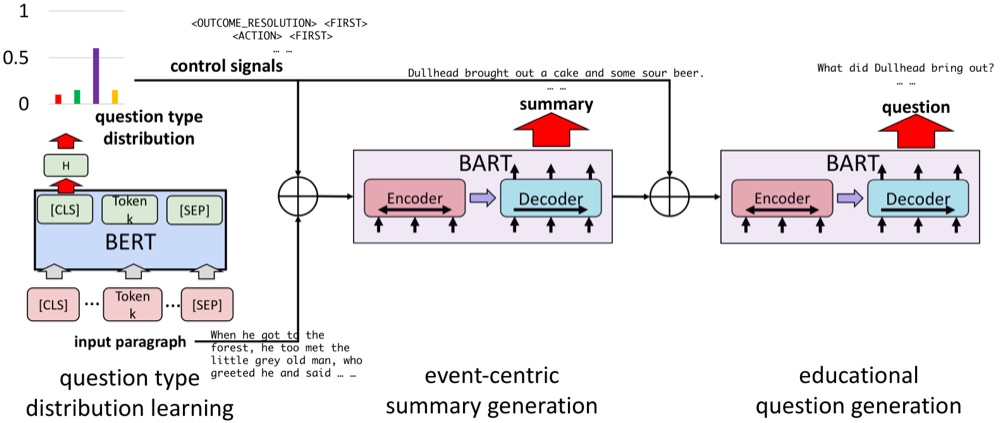
  6. Educational Question Generation of Children Storybooks via Question Type Distribution Learning and Event-Centric Summarization

    Zhenjie Zhao, Yufang Hou, Dakuo Wang, Mo Yu, Chengzhong Liu, Xiaojuan Ma

    ACL 2022 In Proceedings of the 60th Annual Meeting of the Association for Computational Linguistics (Volume 1: Long Papers) ACL AnthologyarXiv
    AI for LearningLLMs and AI Agents
  7. It is AI’s Turn to Ask Humans a Question: Question-Answer Pair Generation for Children’s Story Books

    Bingsheng Yao, Dakuo Wang, Tongshuang Wu, Zheng Zhang, Toby Jia-Jun Li, Mo Yu, Ying Xu

    ACL 2022 In Proceedings of the 60th Annual Meeting of the Association for Computational Linguistics (Volume 1: Long Papers) ACL AnthologyarXiv
    AI for LearningLLMs and AI Agents
  8. Fantastic Questions and Where to Find Them: FairytaleQA–An Authentic Dataset for Narrative Comprehension

    Ying Xu, Dakuo Wang, Mo Yu, Daniel Ritchie, Bingsheng Yao, Tongshuang Wu, Zheng Zhang, Toby Jia-Jun Li, Nora Bradford, Branda Sun, others

    ACL 2022 on. In Proceedings of the 60th Annual Meeting of the Association for Computational Linguistics (Volume 1: Long Papers) ACL Anthology
    AI for LearningLLMs and AI Agents
  9. Organizational Distance Also Matters: How Organizational Distance Among Industrial Research Teams Affect Their Research Productivity

    Dakuo Wang, Michael Muller, Qian Yang, Zijun Wang, Ming Tan, Stacy Hobson

    CSCW 2022 In Proceedings of the ACM on Human-Computer Interaction ACM DL
    Human-AI Collaboration
  10. Group chat ecology in enterprise instant messaging: How employees collaborate through multi-user chat channels on slack

    Dakuo Wang, Haoyu Wang, Mo Yu, Zahra Ashktorab, Ming Tan

    CSCW 2022 Proceedings of the ACM on Human-Computer Interaction ACM DLarXiv
    Human-AI Collaboration
  11. Documentation Matters: Human-Centered AI System to Assist Data Science Code Documentation in Computational Notebooks

    April Yi Wang, Dakuo Wang, Jaimie Drozdal, Michael Muller, Soya Park, Justin D Weisz, Xuye Liu, Lingfei Wu, Casey Dugan

    TOCHI 2022 ACM Trans. on Computer-Human Interaction ACM DLarXiv
    Human-AI Collaboration
  12. Ways of Knowing in HCI (Chinese Edition) (人机交互之道)

    Z. Fu, D. Wang

    Book Tsinghua University Press, Beijing, China
    Community Engagement
  13. Machine learning with multiple constraints

    Parikshit Ram, Dakuo Wang, Deepak Vijaykeerthy, Vaibhav Saxena, Sijia Liu, Arunima Chaudhary, Gregory Bramble, Horst Cornelius Samulowitz, Alexander Gray

    Preprint
    LLMs and AI Agents
  14. Semantic Feature Discovery with Code Mining and Semantic Type Detection

    Kavitha Srinivas, Takaaki Tateishi, Daniel Karl I Weidele, Udayan Khurana, Horst Samulowitz, Toshihiro Takahashi, Dakuo Wang, Lisa Amini

    AAAI 2022 Proceedings of the AAAI Conference on Artificial Intelligence AAAI
    LLMs and AI Agents
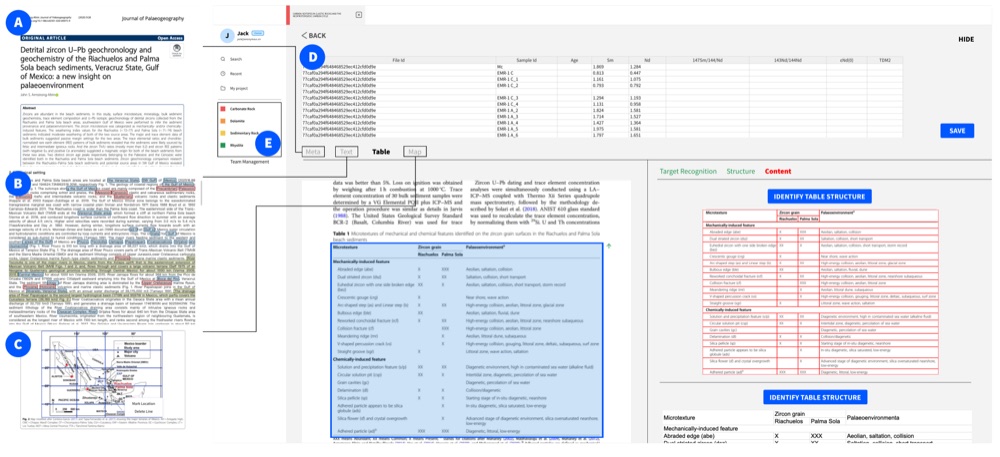
  15. DeepShovel: An Online Collaborative Platform for Data Extraction in Geoscience Literature with AI Assistance

    Shao Zhang, Yuting Jia, Hui Xu, Ying Wen, Dakuo Wang, Xinbing Wang

    Preprint arXiv preprint arXiv
    Human-AI Collaboration
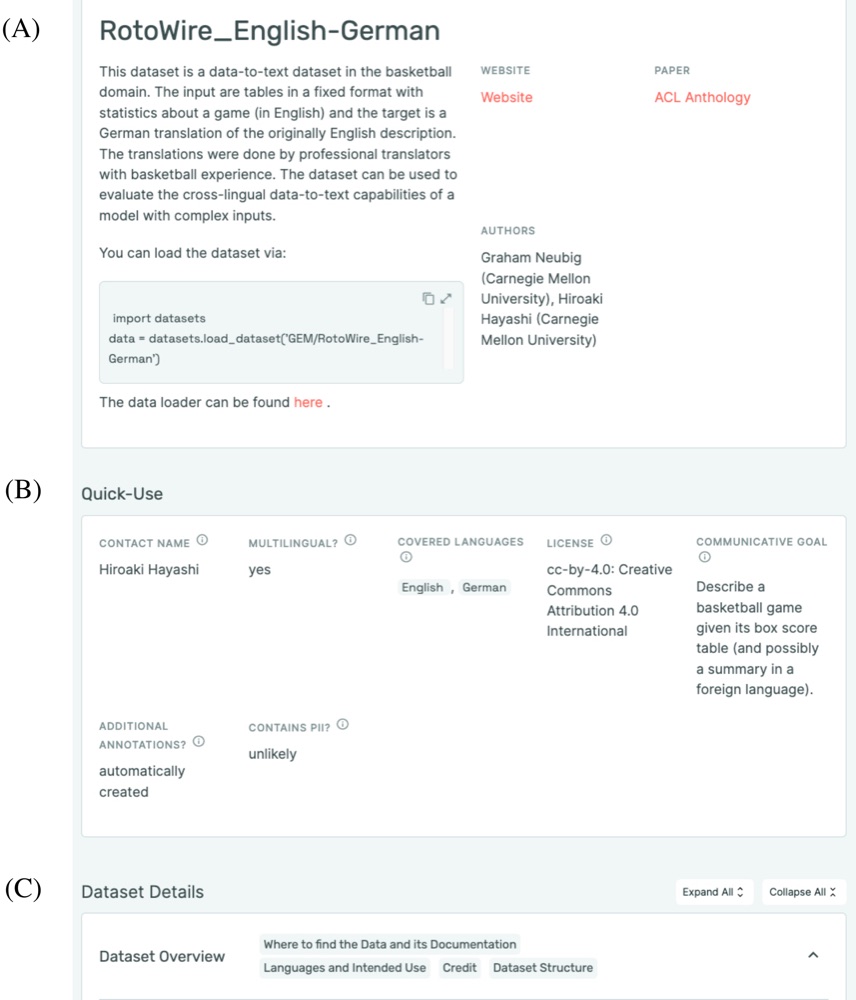
  16. Gemv2: Multilingual nlg benchmarking in a single line of code

    Sebastian Gehrmann, Abhik Bhattacharjee, Abinaya Mahendiran, Alex Wang, Alexandros Papangelis, Aman Madaan, Angelina McMillan-Major, Anna Shvets, Ashish Upadhyay, Bingsheng Yao, others

    EMNLP 2022 Conference on Empirical Methods in Natural Language Processing: System Demonstrations (EMNLP) Earlier as a preprint ACL AnthologyarXiv
    LLMs and AI Agents
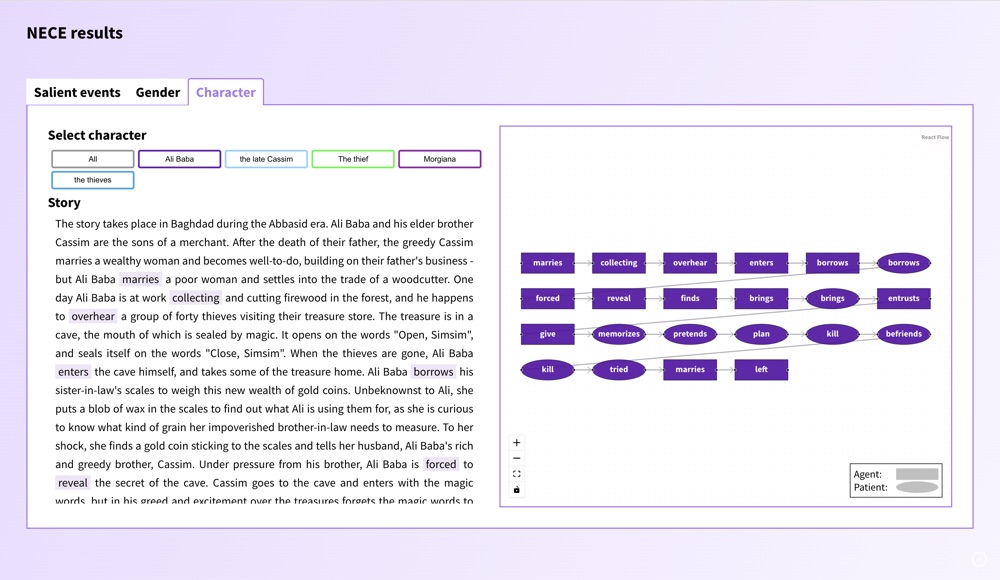
  17. Nece: Narrative event chain extraction toolkit

    Guangxuan Xu, Paulina Toro Isaza, Moshi Li, Akintoye Oloko, Bingsheng Yao, Cassia Sanctos, Aminat Adebiyi, Yufang Hou, Nanyun Peng, Dakuo Wang

    Preprint arXiv preprint arXiv
    LLMs and AI Agents
  18. Human–computer integration: Towards integrating the human body with the computational machine

    Nathan Semertzidis, Josh Andres, Martin Weigel, Suranga Nanayakkara, Rakesh Patibanda, Zhuying Li, Paul Strohmeier, Jarrod Knibbe, Stefan Greuter, Marianna Obrist, others

    FnT HCI Foundations and Trends® in Human-Computer Interaction Now Publishers
    Human-AI Collaboration
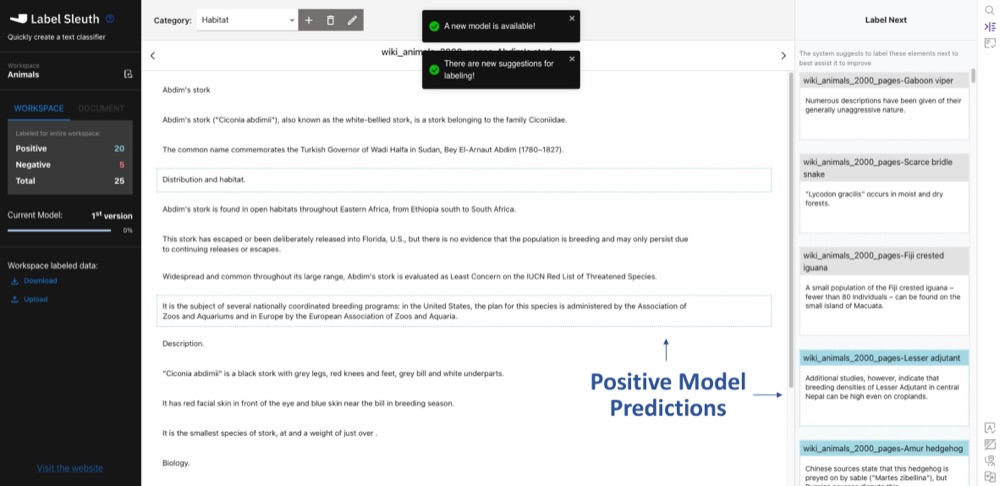
  19. Label Sleuth: From unlabeled text to a classifier in a few hours

    Eyal Shnarch, Alon Halfon, Ariel Gera, Marina Danilevsky, Yannis Katsis, Leshem Choshen, Martin Santillan Cooper, Dina Epelboim, Zheng Zhang, Dakuo Wang, others

    EMNLP 2022 Conference on Empirical Methods in Natural Language Processing: System Demonstrations (EMNLP) Earlier as a preprint ACL AnthologyarXiv
    LLMs and AI Agents
  20. GeoDeepShovel: A platform for building scientific database from geoscience literature with AI assistance

    Shao Zhang, Hui Xu, Yuting Jia, Ying Wen, Dakuo Wang, Luoyi Fu, Xinbing Wang, Chenghu Zhou

    Geosci. Data J. Geoscience Data Journal Wiley
    Human-AI Collaboration
  21. DeepBrain: Enabling Fine-Grained Brain-Robot Interaction through Human-Centered Learning of Coarse EEG Signals from Low-Cost Devices

    Di Wu, Jinhui Ouyang, Ningyi Dai, Mingzhu Wu, Haodan Tan, Hanhui Deng, Yongmei Fan, Dakuo Wang, Zhanpeng Jin

    IMWUT Proceedings of the ACM on Interactive, Mobile, Wearable and Ubiquitous Technologies ACM DL
    LLMs and AI AgentsHuman-AI Collaboration

2021

  1. HAConvGNN: Hierarchical Attention Based Convolutional Graph Neural Network for Code Documentation Generation in Jupyter Notebooks

    Xuye Liu, Dakuo Wang, April Wang, Yufang Hou, Lingfei Wu

    EMNLP 2021 Findings In Findings of the Association for Computational Linguistics: EMNLP 2021 ACL Anthology
    LLMs and AI Agents
  2. D2S: Document-to-Slide Generation Via Query-Based Text Summarization

    Edward Sun, Yufang Hou, Dakuo Wang, Yunfeng Zhang, Nancy XR Wang

    NAACL 2021 In Proceedings of the 2021 Conference of the North American Chapter of the Association for Computational Linguistics: Human Language Technologies ACL Anthology
    LLMs and AI Agents
  3. CASS: Towards building a social-support chatbot for online health community

    Liuping Wang, Dakuo Wang, Feng Tian, Zhenhui Peng, Xiangmin Fan, Zhan Zhang, Mo Yu, Xiaojuan Ma, Hongan Wang

    CSCW 2021 Proceedings of the ACM on Human-Computer Interaction ACM DLarXiv
    AI for HealthcareHuman-Agent Collaboration
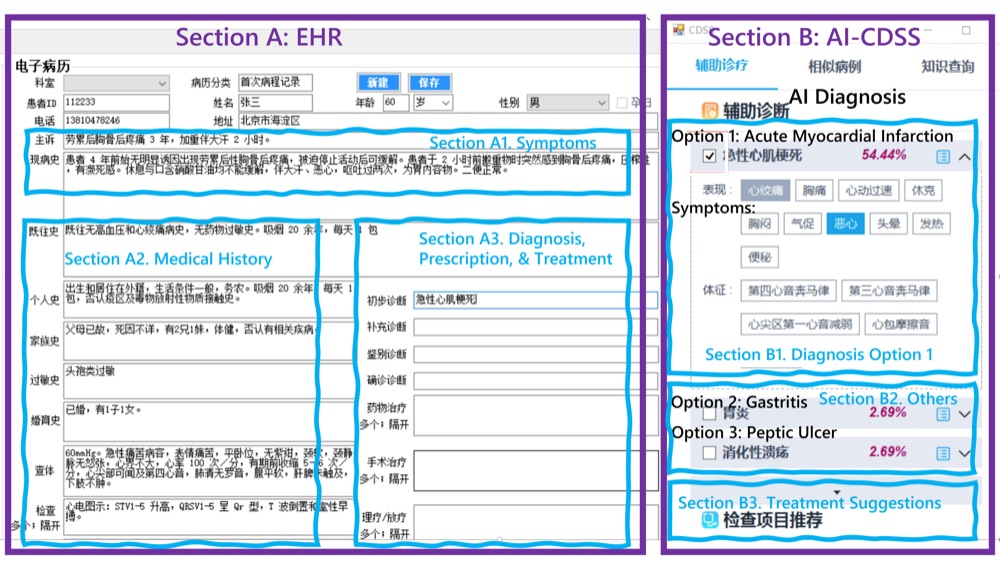
  4. “Brilliant AI doctor” in rural clinics: Challenges in AI-powered clinical decision support system deployment

    Dakuo Wang, Liuping Wang, Zhan Zhang, Ding Wang, Haiyi Zhu, Yvonne Gao, Xiangmin Fan, Feng Tian

    CHI 2021 In Proceedings of the 2021 CHI conference on human factors in computing systems ACM DLarXiv
    AI for Healthcare
  5. How ai developers overcome communication challenges in a multidisciplinary team: A case study

    David Piorkowski, Soya Park, April Yi Wang, Dakuo Wang, Michael Muller, Felix Portnoy

    CSCW 2021 Proceedings of the ACM on Human-Computer Interaction ACM DL
    Human-AI Collaboration
  6. Model lineupper: Supporting interactive model comparison at multiple levels for automl

    Shweta Narkar, Yunfeng Zhang, Q Vera Liao, Dakuo Wang, Justin D Weisz

    IUI 2021 In 26th International Conference on Intelligent User Interfaces ACM DLarXiv
    Human-AI Collaboration
  7. AutoDS: Towards human-centered automation of data science

    Dakuo Wang, Josh Andres, Justin D Weisz, Erick Oduor, Casey Dugan

    CHI 2021 In Proceedings of the 2021 CHI Conference on Human Factors in Computing Systems ACM DLarXiv
    Human-AI Collaboration
  8. Graph-Augmented Code Summarization in Computational Notebooks

    April Yi Wang, Dakuo Wang, Xuye Liu, Lingfei Wu

    IJCAI 2021 IJCAI
    LLMs and AI Agents
  9. Automated data science for relational data

    Hoang Thanh Lam, Beat Buesser, Hong Min, Tran Ngoc Minh, Martin Wistuba, Udayan Khurana, Gregory Bramble, Theodoros Salonidis, Dakuo Wang, Horst Samulowitz

    ICDE 2021 In 2021 IEEE 37th International Conference on Data Engineering (ICDE). IEEE IEEE Xplore
    LLMs and AI Agents
  10. Data-debugging through interactive visual explanations

    Shazia Afzal, Arunima Chaudhary, Nitin Gupta, Hima Patel, Carolina Spina, Dakuo Wang

    PAKDD Workshop 2021 In Trends and Applications in Knowledge Discovery and Data Mining: PAKDD 2021 Workshops, WSPA, MLMEIN, SDPRA, DARAI, and AI4EPT, Delhi, India, May 11, 2021 Proceedings 25. Springer International Publishing Springer
    LLMs and AI Agents
  11. What makes a well-documented notebook? a case study of data scientists’ documentation practices in kaggle

    April Yi Wang, Dakuo Wang, Jaimie Drozdal, Xuye Liu, Soya Park, Steve Oney, Christopher Brooks

    CHI EA 2021 In Extended Abstracts of the 2021 CHI Conference on Human Factors in Computing Systems ACM DL
    Human-AI Collaboration
  12. Designing ai to work with or for people?

    Dakuo Wang, Pattie Maes, Xiangshi Ren, Ben Shneiderman, Yuanchun Shi, Qianying Wang

    CHI EA 2021 In Extended Abstracts of the 2021 CHI Conference on Human Factors in Computing Systems ACM DL
    Community Engagement
  13. Autotext: An end-to-end autoai framework for text

    Arunima Chaudhary, Alayt Issak, Kiran Kate, Yannis Katsis, Abel Valente, Dakuo Wang, Alexandre Evfimievski, Sairam Gurajada, Ban Kawas, Cristiano Malossi, others

    AAAI 2021 In Proceedings of the AAAI Conference on Artificial Intelligence (Vol. 35, No. 18, pp. 16001-16003) AAAI
    LLMs and AI Agents
  14. Effect of ai explanations on human perceptions of patient-facing ai-powered healthcare systems

    Zhan Zhang, Yegin Genc, Dakuo Wang, Mehmet Eren Ahsen, Xiangmin Fan

    J. Med. Syst. 2021 Journal of Medical Systems Springer
    AI for Healthcare
  15. Utilization of self-diagnosis health chatbots in real-world settings: case study

    Xiangmin Fan, Daren Chao, Zhan Zhang, Dakuo Wang, Xiaohua Li, Feng Tian

    JMIR 2021 Journal of Medical Internet Research JMIR
    AI for HealthcareHuman-Agent Collaboration
  16. Same benefits, different communication patterns: Comparing Children’s reading with a conversational agent vs. a human partner

    Ying Xu, Dakuo Wang, Penelope Collins, Hyelim Lee, Mark Warschauer

    Computers & Education 2021 Computers & Education, 161, 104059 ScienceDirect
    AI for LearningHuman-Agent Collaboration
  17. Preserve, promote, or attack? gnn explanation via topology perturbation

    Yi Sun, Abel Valente, Sijia Liu, Dakuo Wang

    Preprint arXiv preprint arXiv
    LLMs and AI Agents
  18. How much automation does a data scientist want?

    Dakuo Wang, Q Vera Liao, Yunfeng Zhang, Udayan Khurana, Horst Samulowitz, Soya Park, Michael Muller, Lisa Amini

    Preprint arXiv preprint arXiv
    Human-AI Collaboration
  19. Patients’ perceptions of using artificial intelligence (AI)-based technology to comprehend radiology imaging data

    Zhan Zhang, Daniel Citardi, Dakuo Wang, Yegin Genc, Juan Shan, Xiangmin Fan

    Health Inform. J. Health Informatics Journal SAGE
    AI for Healthcare
  20. Human-centered AI for data science: A systematic approach

    Dakuo Wang, Xiaojuan Ma, April Yi Wang

    Preprint arXiv preprint arXiv
    Human-AI Collaboration
  21. Towards A Diverse, Inclusive, Accessible and Equitable AAAI International Conference on Web and Social Media (ICWSM)

    Jason RC Nurse, Francielle Vargas, Naeemul Hassan, Dakuo Wang, Panagiotis Andriotis, Amira Ghenai, Kokil Jaidka, Eni Mustafaraj, Kenneth Joseph, Brooke Foucault Welles

    ICWSM 2021
    Community Engagement
  22. How Data Scientists Improve Generated Code Documentation in Jupyter Notebooks.

    Michael J Muller, April Yi Wang, Steven I Ross, Justin D Weisz, Mayank Agarwal, Kartik Talamadupula, Stephanie Houde, Fernando Martinez, John T Richards, Jaimie Drozdal, others

    IUI Workshop IUI Workshops
    Human-AI Collaboration

2020

  1. Exploring Information Needs for Establishing Trust in Automated Data Science Systems

    J. Drozdal, J. Weisz, D. Wang, D. Gaurave, B. Yao, C. Zhao, H. Su

    IUI 2020
    Human-AI Collaboration
  2. AutoAIViz: opening the blackbox of automated artificial intelligence with conditional parallel coordinates

    Daniel Karl I Weidele, Justin D Weisz, Erick Oduor, Michael Muller, Josh Andres, Alexander Gray, Dakuo Wang

    IUI 2020 In Proceedings of the 25th International Conference on Intelligent User Interfaces ACM DL
    Human-AI Collaboration
  3. Next steps for human-computer integration

    Florian Floyd Mueller, Pedro Lopes, Paul Strohmeier, Wendy Ju, Caitlyn Seim, Martin Weigel, Suranga Nanayakkara, Marianna Obrist, Zhuying Li, Joseph Delfa, others

    CHI 2020 In Proceedings of the 2020 CHI Conference on Human Factors in Computing Systems ACM DL
    Human-AI Collaboration
  4. How do data science workers collaborate? roles, workflows, and tools

    Amy X Zhang, Michael Muller, Dakuo Wang

    CSCW 2020 Proceedings of the ACM on Human-Computer Interaction ACM DLarXiv
    Human-AI Collaboration
  5. An ADMM based framework for automl pipeline configuration

    Sijia Liu, Parikshit Ram, Deepak Vijaykeerthy, Djallel Bouneffouf, Gregory Bramble, Horst Samulowitz, Dakuo Wang, Andrew Conn, Alexander Gray

    AAAI 2020 In Proceedings of the AAAI Conference on Artificial Intelligence (Vol. 34, No. 04, pp. 4892-4899) AAAIarXiv
    LLMs and AI Agents
  6. Trust in AutoML: exploring information needs for establishing trust in automated machine learning systems

    Jaimie Drozdal, Justin Weisz, Dakuo Wang, Gaurav Dass, Bingsheng Yao, Changruo Zhao, Michael Muller, Lin Ju, Hui Su

    IUI 2020 In Proceedings of the 2020 ACM International Conference on Intelligent User Interfaces ACM DLarXiv
    Human-AI Collaboration
  7. From human-human collaboration to Human-AI collaboration: Designing AI systems that can work together with people

    Dakuo Wang, Elizabeth Churchill, Pattie Maes, Xiangmin Fan, Ben Shneiderman, Yuanchun Shi, Qianying Wang

    CHI EA 2020 In Extended abstracts of the 2020 CHI conference on human factors in computing systems ACM DL
    Community EngagementHuman-AI Collaboration
  8. AutoAI: Automating the end-to-end ai lifecycle with humans-in-the-loop

    Dakuo Wang, Parikshit Ram, Daniel Karl I Weidele, Sijia Liu, Michael Muller, Justin D Weisz, Abel Valente, Arunima Chaudhary, Dustin Torres, Horst Samulowitz, others

    IUI 2020 In Proceedings of the 25th International Conference on Intelligent User Interfaces Companion ACM DL
    Human-AI Collaboration
  9. Chinese CHI 2020 Workshop

    Xiangmin Fan, Junfeng Yao, Huawei Tu, Dakuo Wang

    CHI EA 2020 In Extended Abstracts of the 2020 CHI Conference on Human Factors in Computing Systems ACM DL
    Community Engagement
  10. Lay individuals’ perceptions of artificial intelligence (AI)-empowered healthcare systems

    Zhan Zhang, Yegin Genc, Aiwen Xing, Dakuo Wang, Xiangmin Fan, Daniel Citardi

    ASIS&T 2020 Proceedings of the Association for Information Science and Technology Wiley
    AI for Healthcare
  11. Solving constrained cash problems with admm

    Parikshit Ram, Sijia Liu, Deepak Vijaykeerthi, Dakuo Wang, Djallel Bouneffouf, Greg Bramble, Horst Samulowitz, Alexander G Gray

    Preprint arXiv preprint arXiv
    LLMs and AI Agents
  12. IBM AutoAI: Human-in-the-Loop Automated Machine Learning Supports Data Scientists to Build Better Models.

    Dakuo Wang, Josh Andres, Justin D Weisz, Erick Oduor, Udayan Khurana, Horst Samulowitz, Arunima Chaudhary, Abel N Valente, Dustin Ramsey Torres, Casey Dugan

    KDD Workshop
    Human-AI CollaborationLLMs and AI Agents

2019

  1. How data scientists work together with domain experts in scientific collaborations: To find the right answer or to ask the right question?

    Yaoli Mao, Dakuo Wang, Michael Muller, Kush R Varshney, Ioana Baldini, Casey Dugan, Aleksandra Mojsilović

    CSCW 2019 Proceedings of the ACM on Human-Computer Interaction ACM DL
    Human-AI Collaboration
  2. Context-aware conversation thread detection in multi-party chat

    Ming Tan, Dakuo Wang, Yupeng Gao, Haoyu Wang, Saloni Potdar, Xiaoxiao Guo, Shiyu Chang, Mo Yu

    EMNLP 2019 In Proceedings of the 2019 Conference on Empirical Methods in Natural Language Processing and the 9th International Joint Conference on Natural Language Processing (EMNLP-IJCNLP) ACL Anthology
    LLMs and AI Agents
  3. Out-of-domain detection for low-resource text classification tasks

    Ming Tan, Yang Yu, Haoyu Wang, Dakuo Wang, Saloni Potdar, Shiyu Chang, Mo Yu

    EMNLP 2019 In Proceedings of the 2019 Conference on Empirical Methods in Natural Language Processing and the 9th International Joint Conference on Natural Language Processing (EMNLP-IJCNLP) ACL Anthology
    LLMs and AI Agents
  4. What can gestures tell? Detecting motor impairment in early Parkinson’s from common touch gestural interactions

    Feng Tian, Xiangmin Fan, Junjun Fan, Yicheng Zhu, Jing Gao, Dakuo Wang, Xiaojun Bi, Hongan Wang

    CHI 2019 In Proceedings of the 2019 CHI Conference on Human Factors in Computing Systems ACM DL
    AI for Healthcare
  5. Extracting multiple-relations in one-pass with pre-trained transformers

    Haoyu Wang, Ming Tan, Mo Yu, Shiyu Chang, Dakuo Wang, Kun Xu, Xiaoxiao Guo, Saloni Potdar

    ACL 2019 In Proceedings of the 57th Annual Meeting of the Association for Computational Linguistics Earlier as a preprint ACL AnthologyarXiv
    LLMs and AI Agents
  6. How data science workers work with data: Discovery, capture, curation, design, creation

    Michael Muller, Ingrid Lange, Dakuo Wang, David Piorkowski, Jason Tsay, Q Vera Liao, Casey Dugan, Thomas Erickson

    CHI 2019 In Proceedings of the 2019 CHI conference on human factors in computing systems ACM DL
    Human-AI Collaboration
  7. Conversational agents: Acting on the wave of research and development

    Richard Jacques, Asbjørn Følstad, Elizabeth Gerber, Jonathan Grudin, Ewa Luger, Andrés Monroy-Hernández, Dakuo Wang

    CHI EA 2019 In Extended Abstracts of the 2019 CHI conference on human factors in computing systems ACM DL
    Community EngagementHuman-Agent Collaboration
  8. HCI in China: Research Agenda, Education Curriculum, Industry Partnership, and Communities Building

    Feng Tian, Xiangshi Ren, Xiangmin Fan, Wei Li, Haipeng Mi, Tun Lu, Chun Yu, Dakuo Wang

    CHI EA 2019 In Extended Abstracts of the 2019 CHI Conference on Human Factors in Computing Systems ACM DL
    Community EngagementAI for Learning
  9. Human-ai collaboration in data science: Exploring data scientists’ perceptions of automated ai

    Dakuo Wang, Justin D Weisz, Michael Muller, Parikshit Ram, Werner Geyer, Casey Dugan, Yla Tausczik, Horst Samulowitz, Alexander Gray

    PACM HCI Proceedings of the ACM on human-computer interaction ACM DL
    Human-AI Collaboration

2018

  1. Face Value? Exploring the effects of embodiment for a group facilitation agent

    Ameneh Shamekhi, Q Vera Liao, Dakuo Wang, Rachel KE Bellamy, Thomas Erickson

    CHI 2018 In Proceedings of the 2018 CHI conference on human factors in computing systems ACM DL
    Human-Agent Collaboration
  2. All Work and No Play? Conversations with a Question-and-Answer Chatbot in the Wild

    Q Vera Liao, Muhammed Mas-ud Hussain, Praveen Chandar, Matthew Davis, Yasaman Khazaeni, Marco Patricio Crasso, Dakuo Wang, Michael Muller, N Sadat Shami, Werner Geyer

    CHI 2018 In Proceedings of the 2018 CHI Conference on Human Factors in Computing Systems ACM DL
    Human-Agent Collaboration
  3. Projecting life onto robots: The effects of cultural factors and design type on multi-level evaluations of robot anthropomorphism

    Haodan Tan, Dakuo Wang, Selma Sabanovic

    RO-MAN 2018 In 2018 IEEE International Symposium on Robot and Human Interactive Communication (RO-MAN) IEEE Xplore
    Human-AI Collaboration
  4. Implicit detection of motor impairment in Parkinson’s disease from everyday smartphone interactions

    Jing Gao, Feng Tian, Junjun Fan, Dakuo Wang, Xiangmin Fan, Yicheng Zhu, Shuai Ma, Jin Huang, Hongan Wang

    CHI EA 2018 Extended Abstracts of the 2018 CHI Conference on Human Factors in Computing Systems ACM DL
    AI for Healthcare
  5. Writing together: Online synchronous collaboration in middle school

    Jenell Krishnan, Andrew Cusimano, Dakuo Wang, Soobin Yim

    JAAL Journal of Adolescent & Adult Literacy Wiley
    AI for LearningHuman-AI Collaboration

2017

  1. Why users do not want to write together when they are writing together: Users’ rationales for today’s collaborative writing practices

    Dakuo Wang, Haodan Tan, Tun Lu

    CSCW 2017 Proceedings of the ACM on Human-Computer Interaction Best Paper Honorable Mention ACM DL
    Human-AI Collaboration
  2. Hacking with NPOs: collaborative analytics and broker roles in civic data hackathons

    Youyang Hou, Dakuo Wang

    CSCW 2017 Proceedings of the ACM on Human-Computer Interaction Best Paper Award ACM DL
    Human-AI Collaboration
  3. Synchronous Collaborative Writing in the Classroom: Undergraduates' Collaboration Practices and their Impact on Writing Style, Quality, and Quantity

    S. Yim, D. Wang, J. S. Olson, V. Vu, M. Warschauer

    CSCW 2017 In Proceedings of the 2017 ACM Conference on Computer Supported Cooperative Work and Social Computing ACM DL
    AI for LearningHuman-AI Collaboration
  4. How people write together now: Beginning the investigation with advanced undergraduates in a project course

    Judith S Olson, Dakuo Wang, Gary M Olson, Jingwen Zhang

    TOCHI 2017 ACM Trans. on Computer-Human Interaction (TOCHI). 24(1), 1-40 ACM DL
    AI for LearningHuman-AI Collaboration

2016

  1. Answerer engagement in an enterprise social question & answering system

    Dakuo Wang, Youyang Hou, Lin Luo, Yingxin Pan

    iConference 2016 IConference 2016 Proceedings IDEALS
    Human-AI Collaboration
  2. Exploring and supporting today’s collaborative writing

    Dakuo Wang

    CHI EA 2016 Proceedings of the 2016 CHI conference extended abstracts on human factors in computing systems ACM DL
    Human-AI Collaboration

2015

  1. Internet censorship in China: Examining user awareness and attitudes

    Dakuo Wang, Gloria Mark

    TOCHI 2015 ACM Trans. on Computer-Human Interaction ACM DL
    Human-AI Collaboration
  2. DocuViz: visualizing collaborative writing

    Dakuo Wang, Judith S Olson, Jingwen Zhang, Trung Nguyen, Gary M Olson

    CHI 2015 In Proceedings of the 33rd Annual ACM conference on human factors in computing systems ACM DL
    Human-AI Collaboration
  3. How students collaboratively write using google docs

    Dakuo Wang, Judith S Olson, Jingwen Zhang, Trung Nguyen, Gary M Olson

    iConference 2015 IConference 2015 Proceedings
    AI for LearningHuman-AI Collaboration